Supporting Students at School with Asthma – Emergency Salbutamol Inhaler Policy

Supporting Students at School with Asthma – Emergency Salbutamol Inhaler

Table of Contents

1. Arrangement for the supply, storage, care and disposal of the inhaler

Tanfield school has a salbutamol inhaler for use in emergencies. This is for any students with asthma, or who have been prescribed an inhaler as reliever medication. The inhaler can be used if the student’s prescribed inhaler is not available (for example, if it is broken or empty). This should be specified in a student's IHP and or written parental consent. If a child has an inhaler such as terbutaline the salbutamol inhaler should be still used by these children if their own inhaler is not accessible - it will still help to relieve their asthma and save their life.

This policy sits alongside our Supporting Students with Medical Conditions policy and should be read in conjunction with this policy. For those students with medical needs there may be an Individual Healthcare Plan in place to identify triggers, symptoms, medication needs and the level of support needed in an emergency.

The emergency inhaler will be stored in the Year Manager’s Hub (pink box), PE block and the Humanities office (not locked away), accessible to all staff. This should be out of reach and sight of students.  Matthew Smith, Graeme Davison, Helen Johnson, Grant Parker, Marie Farrell and Caroline Dixon are responsible for administering the inhaler and Marie Farrell  is responsible for maintaining the emergency inhaler kit.

Students should have their own reliever inhaler at school to treat symptoms and for use in the event of an asthma attack.  If they are able to manage their asthma themselves they should keep their inhaler on them, and if not, it should be easily accessible to them.

The emergency asthma inhaler kit should include:

  • a salbutamol metered dose inhaler
  • at least 2 plastic spacers compatible with the inhaler
  • instructions on using the inhaler and spacer
  • instructions in cleaning and storing the inhaler
  • manufacturer's information
  • a checklist of inhalers; identified by their batch number and expiry date, with monthly checks recorded
  • a note of the arrangements for replacing the inhaler and spacer
  • a list of children permitted to use the emergency inhaler as detailed in the students’ IHP
  • a record of administration (when the inhaler has been used).

The emergency inhaler kit should be kept out of direct sunlight and extreme temperatures (below 30C is appropriate).

The inhaler should be primed when first used - spray 2 puffs, as it can become blocked when not used over a period of time.

To avoid the risk of cross-infection, the plastic spacer should not be reused. It can be given to the student to take home for future personal use.

The inhaler can usually be reused, provided it can be cleaned after use. The inhaler canister should be removed and the plastic inhaler housing the cap should be washed in warm running water, and left to dry in air in a clean, safe place. The canister should be returned to the housing when it is dry, and the cap replaced, and the inhaler returned to the designated storage place.

To dispose of the inhaler the manufacturers’ guidelines usually recommend that spent inhalers are returned to the pharmacy to be recycled, rather than been thrown away.

2. Register

The register of those students who have asthma and those with asthma and an IHP is noted in a tab on the SEND register. Staff are aware of this register and can access information regarding those children with medical needs and those students with asthma.

SEND register

Parents whose child has asthma will be sent an option via the Arbor Parent Portal to consent to the use of an emergency inhaler at Tanfield School. This will be an automated process, with reports being readily available to staff.

For those parents who cannot access the Parent Portal a letter will be sent to inform parents/carers of the emergency salbutamol inhaler use and a consent form (see below).

CONSENT FORM: USE OF EMERGENCY SALBUTAMOL INHALER - Tanfield School

Child showing symptoms of asthma / having asthma attack

1. I can confirm that my child has been diagnosed with asthma / has been prescribed an inhaler [delete as appropriate].

2. My child has a working, in-date inhaler, clearly labelled with their name, which they will bring with them to school every day.

3. In the event of my child displaying symptoms of asthma, and if their inhaler is not available or is unusable, I consent for my child to receive salbutamol from an emergency inhaler held by the school for such emergencies.

Signed:.................................................................................   Date: ………………………………………………

Name (print):……………………………………………………………………………………………………………………………….

Child’s name:……………………………………………………………………………………………………………………………….

Class:……………………………………………………………………………………………………………………………………………

Parent’s address and contact details: ……………………………………………………………………………………………………………………………………………………

……………………………………………………………………………………………………………………………………………………

……………………………………………………………………………………………………………………………………………………

Telephone:………………………………………………………………………………………………………………………………….

E-mail:…………………………………………………………………………………………………………………………………………

LETTER TO INFORM PARENTS OF EMERGENCY SALBUTAMOL INHALER USE

Child's Name:…………………………………………………………………………………………….……………………………..

Class:………………………………………………………………………………………………………………………………………..

Date:……………………………………………

Dear…………………………………………….,

This letter is to formally notify you that …………………………………. has had problems with his / her

breathing today. This happened when ……………………………………………………………………………….

A member of staff helped them to use their asthma inhaler.

They did not have their own asthma inhaler with them, so a member of staff helped them to use the

emergency asthma inhaler containing salbutamol. They were given ……… puffs.

Their own asthma inhaler was not working, so a member of staff helped them to use the emergency

asthma inhaler containing salbutamol. They were given ……… puffs.

Although they soon felt better, we would strongly advise that you have your seen by your own doctor as

soon as possible.

Yours sincerely,

4. Training

Any member of staff may volunteer to take on these responsibilities, but they cannot be required to do so. These staff may already have wider responsibilities for administering medication and/or supporting pupils with medical conditions.

All staff are asked to read this policy and mark as read. This includes recognising the symptom of an asthma attack, aware how to check if a child is on the asthma register, aware of how to access the inhaler and who the designated staff members are in school. Staff can summon the assistance of a designated member of staff to help administer an emergency inhaler, as well as collecting the emergency inhaler and spacer.

A copy of the register should be held by each designated member. This can be taken from the SEND register:

SEND register

HOW TO RECOGNISE AN ASTHMA ATTACK

The signs of an asthma attack are:

  • Persistent cough (when at rest)
  • A wheezing sound coming from the chest (when at rest)
  • Difficulty breathing (the child could be breathing fast and with effort, using all accessory muscles in the upper body)
  • Nasal flaring
  • Unable to talk or complete sentences. Some children will go very quiet.
  • May try to tell you that their chest ‘feels tight’ (younger children may express this as tummy ache)

CALL AN AMBULANCE IMMEDIATELY AND COMMENCE THE ASTHMA ATTACK PROCEDURE WITHOUT DELAY IF THE CHILD

  • Appears exhausted
  • Has a blue/white tinge around lips
  • Is going blue
  • Has collapsed

WHAT TO DO IN THE EVENT OF AN ASTHMA ATTACK

  • Keep calm and reassure the child
  • Encourage the child to sit up and slightly forward
  • Use the child’s own inhaler – if not available, use the emergency inhaler
  • Remain with the child while the inhaler and spacer are brought to them
  • Immediately help the child to take two separate puffs of salbutamol via the spacer
  • If there is no immediate improvement, continue to give two puffs at a time every two minutes, up to a maximum of 10 puffs
  • Stay calm and reassure the child. Stay with the child until they feel better. The child can return to school activities when they feel better
  • If the child does not feel better or you are worried at ANYTIME before you have reached 10 puffs, CALL 999 FOR AN AMBULANCE
  • If an ambulance does not arrive in 10 minutes give another 10 puffs in the same way

The Asthma UK films on using metered-dose inhalers and spacers are particularly valuable as training materials:

http://www.asthma.org.uk/knowledge-bank-treatment-and-medicines-using-your-inhalers

Students with inhalers will also be able to demonstrate to their teacher or Year Manager how they use it.

Our School Nurse, Alison Johnson can also be contacted to offer training.

5. Record keeping

The governing body will ensure that written records are kept of all medicine administered to students. Parents will be informed if their child has been unwell at school.

IHPs are kept in a child's file in the shared area/learning support folder and a paper copy is also held on file with the Year Manager.

Tanfield School record of medicine administered to an individual child

Name of child

Date medicine provided by parent

Group/class/form

Quantity received

Name and strength of medicine

Expiry date

Quantity returned

Dose and frequency of medicine

Date

Time Given

Dose Given

Total Amount Left

Name of member of staff

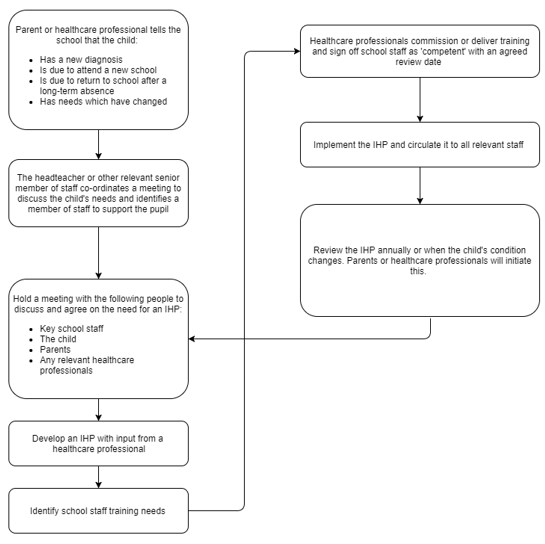
Appendix 1 – Being notified a child has a medical condition

The flowchart outlines an 8-step process for managing a pupil's Individual Health Plan (IHP):   Initial Notification: A parent or healthcare professional informs the school that a child has a new diagnosis, is attending a new school, is returning after a long-term absence, or has changing needs.   Coordination: The headteacher or a senior staff member coordinates a meeting and identifies a staff member to support the pupil.   Planning Meeting: A meeting is held with key school staff, the child, parents, and healthcare professionals to discuss and agree on the need for an IHP.   IHP Development: The IHP is developed with input from a healthcare professional.   Training Identification: School staff training needs are identified.   Training & Certification: Healthcare professionals commission or deliver training and sign off staff as "competent" with an agreed review date.   Implementation: The IHP is implemented and circulated to all relevant staff.   Ongoing Review: The IHP is reviewed annually or whenever the child's condition changes, initiated by parents or healthcare professionals. This step loops back to the planning meeting (Step 3).

Appendix 2 – Individual Healthcare Plan

Tanfield School Individual Healthcare Plan

Pupil name:

Address:

Date of Birth:

Form Class:

Medical Condition: To include triggers, signs, symptoms & treatments

Name of condition:

Triggers:

Signs:

Symptoms:

Treatment:

Date plan drawn up:

Review date (annually):

CONTACT INFORMATION

Family Contact 1

Name:           

Phone No

(work):

(home):

(mobile):

Relationship:

Family Contact 2

Name:           

Phone No:     

(work):

(home):

(mobile):

Relationship:


GP

Name:

Address:

Phone No:

Clinic/Hospital Contact

Name:

Phone No:

Describe medical condition and give details of pupil’s individual symptoms:

Daily care requirements (e.g. before sport/at lunchtime): Include medication (dose, side effects & storage, other treatments, time, facilities, equipment, testing ,access to food & drink used to manage their condition, dietary requirements & environmental issues; e.g. crowded corridors, travel time between lessons.

Describe what constitutes an emergency for the pupil, and the action to be taken if this occurs: (Include who to contact & contingency arrangements)

Follow up care:

Who is responsible in an emergency (State if different on off-site activities): training needs, expectations of their role, cover arrangements for when they are unavailable.

Signed

Date

Parent/Carer

Pupil (where appropriate)

Headteacher

SENCO

GP

Appendix 3 – Parental agreement for a school to administer medicine template

The school will not give your child medicine unless you complete and sign this form, and the school has a policy that the staff can administer medicine.

Tanfield School medicine administering form

Date for review to be initiated by

Name of child

Date of birth

Group/class/form

Medical condition or illness

Medicine

Name/type of medicine

(as described on the container)

Expiry date

Dosage and method

Timing

Total amount received

Special precautions/other instructions

Are there any side effects that the school/setting needs to know about?

Self-administration – y/n

Procedures to take in an emergency

NB: Medicines must be in the original container as dispensed by the pharmacy

Contact Details

Name

Daytime telephone no.

Relationship to child

Address

I understand that I must deliver the medicine personally to a member of office staff.

The above information is, to the best of my knowledge, accurate at the time of writing and I give consent to school/setting staff administering medicine in accordance with the school/setting policy. I will inform the school/setting immediately, in writing, if there is any change in dosage or frequency of the medication or if the medicine is stopped.

Signature(s)                                                                                     Date

Appendix 4 – Record of medicine administered to an individual child template

Tanfield School record of medicine administered to an individual child

Name of child

Date medicine provided by parent

Group/class/form

Quantity received

Name and strength of medicine

Expiry date

Quantity returned

Dose and frequency of medicine

Date

Time Given

Dose Given

Total Amount Left

Name of member of staff

Staff signature

Appendix 5 – Record of medicine administered to all children

Date of Completion

Child’s name

Name of Medicine

Period of Administration

Any Reactions

Signature of Staff

Print Name

Appendix 6 – Staff training record – administration of medicines

Name of school/setting:

Name:

Type of training received:

Date of training completed:

Training provided by:

Profession and title:

I confirm that ______________________________has received the training detailed above and is competent to carry out any necessary treatment.

Trainer’s signature

Date

I confirm that I have received the training detailed above.

Staff signature

Date

Suggested review date

Appendix 7 – Model letter inviting parents to contribute to Individual Healthcare Plan development

Dear Parent/Carer

RE: DEVELOPING AN INDIVIDUAL HEALTHCARE PLAN FOR YOUR CHILD

Thank you for informing us of your child’s medical condition. I enclose a copy of the school’s policy for supporting pupils at school with medical conditions for your information.

A central requirement of the policy is for an individual healthcare plan (IHP) to be prepared, setting out what support each pupil needs and how this will be provided. Individual healthcare plans are developed in partnership with the school, parents/carers, pupils, and the relevant healthcare professional who can advise on your child’s case.  The aim is to ensure that we know how to support your child effectively and to provide clarity about what needs to be done, when and by whom. We will need to make judgements about how your child’s medical condition impacts their ability to participate fully in school life, and the level of detail within plans will depend on the complexity of their condition and the degree of support needed.

A meeting has been arranged (date to be confirmed) to start the process of developing your child’s individual health care plan. You will have the opportunity to discuss your child’s needs with Mrs Johnson (SENDCo), Mrs Alison Johnson (School Nurse Practitioner), Mr Jonathan Coates (Health & Safety Officer) and Mr Jonathan Coates (School Business Manager). I hope that this is convenient for you and would be grateful if you could confirm whether you are able to attend by completing the tear off slip below, indicating your approximate time of arrival, and returning to the school office.

Please let us know if you would like us to invite another medical practitioner, healthcare professional or specialist and provide any other evidence you would like us to consider at the meeting as soon as possible.

If you are unable to attend, it would be helpful if you could complete the attached individual healthcare plan template and return it before (insert date), together with any relevant evidence, for consideration at the drop in session.

If you have any questions, please don’t hesitate to contact Mrs S Johnson in school.

Yours sincerely,

S Clough

Headteacher

✂- - - - - - - - - - - - - - - - - - - - - - - - - - - - - - - - - - - - - - - - - - - - - - - - - - - - - - - - - - - -

Childs name - - - - - - - - - - - - - - - - - - - - - - - - -  Tutor Group - - - - - - - - - - - - - -

I will be attending the drop in session at approximately  - - - - - - - -  pm.   Yes/No

I will be bringing along a specialist to the session Y/N

Parent/Carer signature - - - - - - - - - - - - - - - - - - - - - - - - - - - -   Date  - - - - - - - - - - -

Appendix 8 - Salbutamol Inhaler Actuation (Puff) Chart

Name of Child:  ______________________________Date of Birth: __________________

OR School Emergency Inhaler: _______________________________________________________

Inhaler Batch Number: _____________________________________________________________

Inhaler Expiry Date: _______________________________________________________________

Each salbutamol inhaler contains 200 actuations (puffs). It is important to record the actuations used in order to know when to prepare for replacement of the inhaler. Each single actuation should be recorded with a clear strike through the number using black ink.

This chart can be used for each individual child’s salbutamol inhaler if it remains in school care and does not go between home and school. However, it should also be used for each of the school emergency inhalers.  Consider how you can easily identify each emergency inhaler, as well as using the batch number.

1

2

3

4

5

6

7

8

9

10

11

12

13

14

15

16

17

18

19

20

21

22

23

24

25

26

27

28

29

30

31

32

33

34

35

36

37

38

39

40

41

42

43

44

45

46

47

48

49

50

51

52

53

54

55

56

57

58

59

60

61

62

63

64

65

66

67

68

69

70

71

72

73

74

75

76

77

78

79

80

81

82

83

84

85

86

87

88

89

90

91

92

93

94

95

96

97

98

99

100

101

102

103

104

105

106

107

108

109

110

111

112

113

114

115

116

117

118

119

120

121

122

123

124

125

126

127

128

129

130

131

132

133

134

135

136

137

138

139

140

141

142

143

144

145

146

147

148

149

150

151

152

153

154

155

156

157

158

159

160

161

162

163

164

165

166

167

168

169

170

171

172

173

174

175

176

177

178

179

180

181

182

183

184

185

186

187

188

189

190

191

192

193

194

195

196

197

198

199

200

Please remember to record actuations when you test/prime your inhaler. The Ventolin Evohaler patient information leaflet recommend the following:

When using the inhaler for the first time, test that it is working. To make sure that it works, shake it well, point the mouthpiece away from you and press the canister to release two puffs into the air.

If you have not used the inhaler for 5 days or more, shake it well and release two puffs of medicine into the air.