Supporting Pupils at School with Medical Conditions Policy

Supporting Pupils at School with Medical Conditions

Table of Contents

1. Aims

This policy aims to ensure that:

  • Pupils, staff and parents understand how our school will support pupils with medical conditions
  • Pupils with medical conditions are properly supported to allow them to access the same education as other pupils, including school trips and sporting activities

The governing body will implement this policy by:

  • Making sure sufficient staff are suitably trained
  • Making staff aware of pupil’s condition, where appropriate
  • Making sure there are cover arrangements to ensure someone is always available to support pupils with medical conditions
  • Providing supply teachers with appropriate information about the policy and relevant pupils
  • Developing and monitoring individual healthcare plans (IHPs)

The named person with responsibility for implementing this policy is Sarah Douglas.

2. Legislation and statutory requirements

This policy meets the requirements under Section 100 of the Children and Families Act 2014, which places a duty on governing body to make arrangements for supporting pupils at their school with medical conditions.

It is also based on the Department for Education’s statutory guidance: Supporting pupils at school with medical conditions.

3. Roles and responsibilities

3.1 The Governing Body

The governing body has ultimate responsibility to make arrangements to support pupils with medical conditions. The governing body will ensure that sufficient staff have received suitable training and are competent before they are responsible for supporting children with medical conditions.

3.2 The SENDCo

The SENDCo will:

  • Make sure all staff are aware of this policy and understand their role in its implementation
  • Ensure that there is a sufficient number of trained staff available to implement this policy and deliver against all individual healthcare plans (IHPs), including in contingency and emergency situations
  • Take overall responsibility for the development of IHPs
  • Make sure that school staff are appropriately insured and aware that they are insured to support pupils in this way
  • Contact the school nursing service in the case of any pupil who has a medical condition that may require support at school, but who has not yet been brought to the attention of the school nurse
  • Ensure that systems are in place for obtaining information about a child’s medical needs and that this information is kept up to date

3.3 Staff

Supporting pupils with medical conditions during school hours is not the sole responsibility of one person. Any member of staff may be asked to provide support to pupils with medical conditions, although they will not be required to do so. This includes the administration of medicines.

Those staff who take on the responsibility to support pupils with medical conditions will receive sufficient and suitable training, and will achieve the necessary level of competency before doing so.

Teachers will take into account the needs of pupils with medical conditions that they teach. Information can be accessed in the SEND register/Medical register. All staff will know what to do and respond accordingly when they become aware that a pupil with a medical condition needs help.

3.4 Parents

Parents will:

  • Provide the school with sufficient and up-to-date information about their child’s medical needs
  • Be involved in the development and review of their child’s IHP and may be involved in its drafting
  • Carry out any action they have agreed to as part of the implementation of the IHP e.g. provide medicines and equipment

3.5 Pupils

Pupils with medical conditions will often be best placed to provide information about how their condition affects them. Pupils should be fully involved in discussions about their medical support needs and contribute as much as possible to the development of their IHPs. They are also expected to comply with their IHPs.

3.6 School nurses and other healthcare professionals

Our school nursing service will notify the school when a pupil has been identified as having a medical condition that will require support in school. This will be before the pupil starts school, wherever possible.

Healthcare professionals, such as GPs and paediatricians, will liaise with the school nurses and notify them of any pupils identified as having a medical condition

4. Equal opportunities

Our school is clear about the need to actively support pupils with medical conditions to participate in school trips and visits, or in sporting activities, and not prevent them from doing so.

The school will consider what reasonable adjustments need to be made to enable these pupils to participate fully and safely on school trips, visits and sporting activities.

Risk assessments will be carried out so that planning arrangements take account of any steps needed to ensure that pupils with medical conditions are included. In doing so, pupils, their parents and any relevant healthcare professionals will be consulted.

5. Being notified that a child has a medical condition

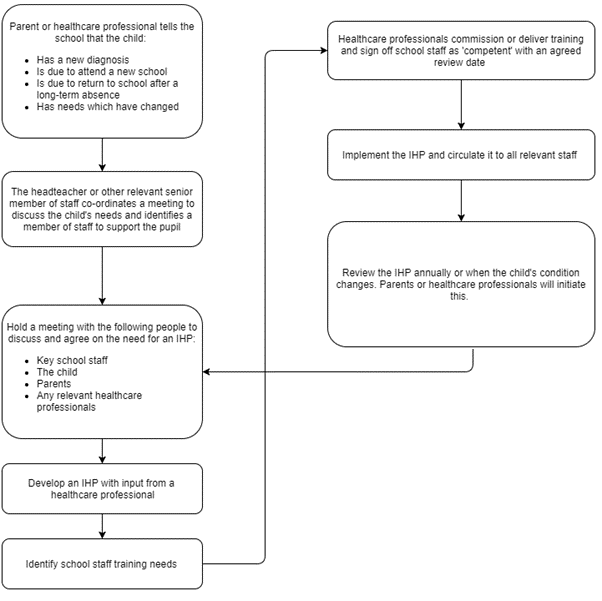
When the school is notified that a pupil has a medical condition, the process outlined below will be followed to decide whether the pupil requires an IHP.

The school will make every effort to ensure that arrangements are put into place within 2 weeks, or by the beginning of the relevant term for pupils who are new to our school.

See Appendix 1.

6. Individual healthcare plans

The Headteacher has overall responsibility for the development of IHPs for pupils with medical conditions. This has been delegated to Sarah Johnson and Niqui McConnell.

Plans will be reviewed at least annually, or earlier if there is evidence that the pupil’s needs have changed.

Plans will be developed with the pupil’s best interests in mind and will set out:

  • What needs to be done
  • When
  • By whom

Not all pupils with a medical condition will require an IHP. It will be agreed with a healthcare professional and the parents when an IHP would be inappropriate or disproportionate. This will be based on evidence. If there is not a consensus, the headteacher will make the final decision.

Plans will be drawn up in partnership with the school, parents and a relevant healthcare professional, such as the school nurse, specialist or paediatrician, who can best advise on the pupil’s specific needs. The pupil will be involved wherever appropriate.

IHPs will be linked to, or become part of, any statement of special educational needs (SEN) or education, health and care (EHC) plan. If a pupil has SEN but does not have a statement or EHC plan, the SEN will be mentioned in the IHP.

The level of detail in the plan will depend on the complexity of the child’s condition and how much support is needed. The governing body and Sarah Johnson will consider the following when deciding what information to record on IHPs:

  • The medical condition, its triggers, signs, symptoms and treatments
  • The pupil’s resulting needs, including medication (dose, side effects and storage) and other treatments, time, facilities, equipment, testing, access to food and drink where this is used to manage their condition, dietary requirements and environmental issues, e.g. crowded corridors, travel time between lessons
  • Specific support for the pupil’s educational, social and emotional needs. For example, how absences will be managed, requirements for extra time to complete exams, use of rest periods or additional support in catching up with lessons, counselling sessions
  • The level of support needed, including in emergencies. If a pupil is self-managing their medication, this will be clearly stated with appropriate arrangements for monitoring
  • Who will provide this support, their training needs, expectations of their role and confirmation of proficiency to provide support for the pupil’s medical condition from a healthcare professional, and cover arrangements for when they are unavailable
  • Who in the school needs to be aware of the pupil’s condition and the support required
  • Arrangements for written permission from parents and the headteacher for medication to be administered by a member of staff, or self-administered by the pupil during school hours
  • Separate arrangements or procedures required for school trips or other school activities outside of the normal school timetable that will ensure the pupil can participate, e.g. risk assessments
  • Where confidentiality issues are raised by the parent/pupil, the designated individuals to be entrusted with information about the pupil’s condition
  • What to do in an emergency, including who to contact, and contingency arrangements

7. Managing medicines

Prescription and non-prescription medicines will only be administered at school:

  • When it would be detrimental to the pupil’s health or school attendance not to do so and
  • Where we have parents’ written consent

The only exception to this is where the medicine has been prescribed to the pupil without the knowledge of the parents.

Pupils under 16 will not be given medicine containing aspirin unless prescribed by a doctor.

Anyone giving a pupil any medication (for example, for pain relief) will first check maximum dosages and when the previous dosage was taken. Parents will always be informed and record medicine administered. See Appendix 4 and 5.

The school will only accept prescribed medicines that are:

  • In-date
  • Labelled (student name)
  • Provided in the original container, as dispensed by the pharmacist, and include instructions for administration, dosage and storage

The school will accept insulin that is inside an insulin pen or pump rather than its original container, but it must be in date.

All medicines will be stored safely in the Hub with Year Managers or in the Link with Miss Dixon (Assistant SENDCo) in a locked cabinet. Pupils will be informed about where their medicines are at all times and be able to access them immediately. Medicines and devices such as asthma inhalers, blood glucose testing meters and adrenaline pens will always be readily available to pupils and not locked away.

Medicines will be returned to parents to arrange for safe disposal when no longer required.

7.1 Controlled drugs

Controlled drugs are prescription medicines that are controlled under the Misuse of Drugs Regulations 2001 and subsequent amendments, such as morphine or methadone.

A pupil who has been prescribed a controlled drug may have it in their possession if they are competent to do so, but they must not pass it to another pupil to use. All other controlled drugs are kept in a secure cupboard in the Hub/Link and only the pastoral team and Assistant SENDCo will have access.

Controlled drugs will be easily accessible in an emergency and a record of any doses used and the amount held will be kept.

7.2 Pupils managing their own needs

Pupils who are competent will be encouraged to take responsibility for managing their own medicines and procedures. This will be discussed with parents and it will be reflected in their IHPs.

Pupils will be allowed to carry their own medicines and relevant devices wherever possible. Staff will not force a pupil to take a medicine or carry out a necessary procedure if they refuse, but will follow the procedure agreed in the IHP and inform parents so that an alternative option can be considered, if necessary.

7.3 Unacceptable practice

School staff should use their discretion and judge each case individually with reference to the pupil’s IHP, but it is generally not acceptable to:

  • Prevent pupils from easily accessing their inhalers and medication, and administering their medication when and where necessary
  • Assume that every pupil with the same condition requires the same treatment
  • Ignore the views of the pupil or their parents
  • Ignore medical evidence or opinion (although this may be challenged)
  • Send children with medical conditions home frequently for reasons associated with their medical condition or prevent them from staying for normal school activities, including lunch, unless this is specified in their IHPs
  • If the pupil becomes ill, send them to the school office or medical room unaccompanied or with someone unsuitable
  • Penalise pupils for their attendance record if their absences are related to their medical condition, e.g. hospital appointments
  • Prevent pupils from drinking, eating or taking toilet or other breaks whenever they need to in order to manage their medical condition effectively
  • Require parents, or otherwise make them feel obliged, to attend school to administer medication or provide medical support to their pupil, including with toileting issues. No parent should have to give up working because the school is failing to support their child’s medical needs
  • Prevent pupils from participating, or create unnecessary barriers to pupils participating in any aspect of school life, including school trips, e.g. by requiring parents to accompany their child
  • Administer, or ask pupils to administer, medicine in school toilets

8. Emergency procedures

Staff will follow the school’s normal emergency procedures (for example, calling 999). All pupils’ IHPs will clearly set out what constitutes an emergency and will explain what to do.

If a pupil needs to be taken to hospital, staff will stay with the pupil until the parent arrives, or accompany the pupil to hospital by ambulance.

9. Training

Staff who are responsible for supporting pupils with medical needs will receive suitable and sufficient training to do so.

The training will be identified during the development or review of IHPs. Staff who provide support to pupils with medical conditions will be included in meetings where this is discussed.

The relevant healthcare professionals will lead on identifying the type and level of training required and will agree this with the SENDCO, Sarah Johnson. Training will be kept up to date.

Training will:

  • Be sufficient to ensure that staff are competent and have confidence in their ability to support the pupils
  • Fulfil the requirements in the IHPs
  • Help staff to have an understanding of the specific medical conditions they are being asked to deal with, their implications and preventative measures

Healthcare professionals will provide confirmation of the proficiency of staff in a medical procedure, or in providing medication.

All staff will receive training so that they are aware of this policy and understand their role in implementing it, for example, with preventative and emergency measures so they can recognise and act quickly when a problem occurs. This will be provided for new staff during their induction.

10. Record keeping

The governing body will ensure that written records are kept of all medicine administered to pupils. Parents will be informed if their pupil has been unwell at school. Please see Appendix 4 and 5.

IHPs are kept in a readily accessible place which all staff are aware of.

11. Liability and indemnity

The governing body will ensure that the appropriate level of insurance is in place and appropriately reflects the school’s level of risk.

The details of the school’s insurance policy are provided in Appendix 8.

12. Complaints

Parents with a complaint about their child’s medical condition should discuss these directly with the SENDCo, Sarah Johnson in the first instance. If the SENDCo, Sarah Johnson, cannot resolve the matter, they will direct parents to the school’s complaints procedure.

13. Monitoring arrangements

This policy will be reviewed and approved by the governing body every year.

This policy links to the following policies:

  • Accessibility plan
  • Complaints
  • Equality information and objectives
  • First aid
  • Health and safety
  • Safeguarding
  • Special educational needs information report and policy

Appendix 1 Being notified a child has a medical condition

Flowchart detailing the school safeguarding and mental health risk assessment procedure, divided into Acute, High, and Low/Medium risk pathways.

Appendix 2 Individual healthcare plan

Tanfield School Individual Healthcare Plan

Pupil name:
Address:


Date of Birth:
Form Class:


Medical Condition: To include triggers, signs, symptoms & treatments

Name of condition:

Triggers:

Signs:

Symptoms:

Treatment:


Date plan drawn up:

Review date (annually):


CONTACT INFORMATION

Family Contact 1

Name:           
Phone No
(work):             
(home):                                
(mobile):                                
Relationship:

Family Contact 2

Name:           
Phone No:     
(work):             
(home):                                 
(mobile):                                
Relationship:

GP

Name:
Address:
Phone No:

Clinic/Hospital Contact

Name:

Phone No:

Describe medical condition and give details of pupil’s individual symptoms:


Daily care requirements (e.g. before sport/at lunchtime): Include medication (dose, side effects & storage, other treatments, time, facilities, equipment, testing ,access to food & drink used to manage their condition, dietary requirements & environmental issues; e.g. crowded corridors, travel time between lessons.


Describe what constitutes an emergency for the pupil, and the action to be taken if this occurs: (Include who to contact & contingency arrangements)


Follow up care:


Who is responsible in an emergency (State if different on off-site activities): training needs, expectations of their role, cover arrangements for when they are unavailable.


Signed

Date

Parent/Carer


Pupil (where appropriate)


Headteacher


SENCO


GP


Appendix 3 Parental agreement for a school to administer medicine template

The school will not give your child medicine unless you complete and sign this form, and the school has a policy that the staff can administer medicine.

Tanfield School medicine administering form


Date for review to be initiated by

Name of child

Date of birth

Group/class/form

Medical condition or illness


Medicine


Name/type of medicine

(as described on the container)

Expiry date

Dosage and method

Timing

Total amount received

Special precautions/other instructions

Are there any side effects that the school/setting needs to know about?

Self-administration – y/n

Procedures to take in an emergency

NB: Medicines must be in the original container as dispensed by the pharmacy


Contact Details

Name

Daytime telephone no.

Relationship to child

Address

I understand that I must deliver the medicine personally to a member of office staff.

The above information is, to the best of my knowledge, accurate at the time of writing and I give consent to school/setting staff administering medicine in accordance with the school/setting policy. I will inform the school/setting immediately, in writing, if there is any change in dosage or frequency of the medication or if the medicine is stopped.

Signature(s)                                                                              Date


Appendix 4 Record of medicine administered to an individual child template

Tanfield School record of medicine administered to an individual child

Name of child

Date medicine provided by parent

Group/class/form

Quantity received

Name and strength of medicine

Expiry date

Quantity returned

Dose and frequency of medicine

Date

Time Given

Dose Given

Total Amount Left

Name of member of staff


Appendix 5 Record of medicine administered to all children

Tanfield School

Date of Completion

Child’s name

Name of Medicine

Period of Administration

Any Reactions

Signature of Staff

Print Name


Appendix 6 Staff training record – administration of medicines

Name of school/setting:

Name:

Type of training received:

Date of training completed:

Training provided by:

Profession and title:

I confirm that ______________________________has received the training detailed above and is competent to carry out any necessary treatment.

Trainer’s signature

Date

I confirm that I have received the training detailed above.

Staff signature

Date

Suggested review date

Appendix 7 Model letter inviting parents to contribute to individual healthcare plan development

Dear Parent/Carer

RE: DEVELOPING AN INDIVIDUAL HEALTHCARE PLAN FOR YOUR CHILD

Thank you for informing us of your child’s medical condition. I enclose a copy of the school’s policy for supporting pupils at school with medical conditions for your information.

A central requirement of the policy is for an individual healthcare plan (IHP) to be prepared, setting out what support each pupil needs and how this will be provided. Individual healthcare plans are developed in partnership with the school, parents/carers, pupils, and the relevant healthcare professional who can advise on your child’s case.  The aim is to ensure that we know how to support your child effectively and to provide clarity about what needs to be done, when and by whom. We will need to make judgements about how your child’s medical condition impacts their ability to participate fully in school life, and the level of detail within plans will depend on the complexity of their condition and the degree of support needed.

A meeting has been arranged (date to be confirmed) to start the process of developing your child’s individual health care plan. You will have the opportunity to discuss your child’s needs with Mrs Johnson (SENDCo), Mrs Alison Johnson (School Nurse Practitioner), Mr Jonathan Coates (Health & Safety Officer) and Mr Jonathan Coates (School Business Manager). I hope that this is convenient for you and would be grateful if you could confirm whether you are able to attend by completing the tear off slip below, indicating your approximate time of arrival, and returning to the school office.

Please let us know if you would like us to invite another medical practitioner, healthcare professional or specialist and provide any other evidence you would like us to consider at the meeting as soon as possible.

If you are unable to attend, it would be helpful if you could complete the attached individual healthcare plan template and return it before (insert date), together with any relevant evidence, for consideration at the drop in session.

If you have any questions, please don’t hesitate to contact Mrs S Johnson in school.

Yours sincerely,

S Clough

Headteacher

✂- - - - - - - - - - - - - - - - - - - - - - - - - - - - - - - - - - - - - - - - - - - - - - - - - - - - - - - - - - - -

Childs name - - - - - - - - - - - - - - - - - - - - - - - - -  Tutor Group - - - - - - - - - - - - - -

I will be attending the drop in session at approximately  - - - - - - - -  pm.   Yes/No

I will be bringing along a specialist to the session Y/N

Parent/Carer signature - - - - - - - - - - - - - - - - - - - - - - - - - - - -   Date  - - - - - - - - - - -

Appendix 8 Liability and indemnity insurance

Certificate of Employers’ Liability Insurance (a)

(Where required by regulation 5 of the Employers' Liability (Compulsory Insurance) Regulations 1998 (the Regulations) as amended by the Employers’ Liability (Compulsory Insurance) (Amendment) Regulations 2008, a copy of this certificate must be displayed at all places where you employ persons covered by the policy or an electronic copy of the certificate must be retained and be reasonably accessible to each employee to whom it relates).

Policy number

KSC-242115-6123

1. Name of policyholder

TANFIELD SCHOOL

2. Date of commencement of insurance policy

1st September 2025

3. Date of expiry of insurance policy

31st August 2026

We hereby certify that subject to paragraph 2:

1.       The policy to which this certificate relates satisfies the requirements of the relevant law applicable in Great Britain, Northern Ireland, the Isle of Man, the Island of Jersey, the Island of Guernsey and the Island of Alderney (b).

2.       (a) The minimum amount of cover provided by this policy is no less than £5 million (c).

Signed on behalf of Zurich Insurance Company Ltd (Authorised Insurer).

Drazen Jaksic

Chief Executive Officer of Zurich Insurance Company Ltd, UK Branch

Notes

(a)     Where the employer is a company to which regulation 3(2) of the Regulations applies, the certificate shall state in a prominent place, either that the policy covers the holding company and all its subsidiaries, or that the policy covers the holding company and all its subsidiaries except any specifically excluded by name, or that the policy covers the holding company and only the named subsidiaries.

(b)     Specify applicable law as provided for in regulation 4(6) of the Regulations.

(c)     See regulation 3(1) of the Regulations and delete whichever of paragraphs 2(a) or 2(b) does not apply. Where 2(b) is applicable, specify the amount of cover provided by the relevant policy.

Zurich Municipal is a trading name of Zurich Insurance Company Ltd. A public limited company incorporated in Switzerland. Registered in the

Canton of Zurich, No. CHE-105.833.114, registered offices at Mythenquai 2, 8002 Zurich. UK Branch registered in England and Wales no

BR000105. UK Branch Head Office: The Zurich Centre, 3000 Parkway, Whiteley, Fareham, Hampshire PO15 7JZ. Zurich Insurance Company Ltd is authorised and regulated in Switzerland by the Swiss Financial Market Supervisory Authority FINMA. Authorised by the Prudential Regulation Authority. Subject to regulation by the Financial Conduct Authority and limited regulation by the Prudential Regulation Authority. Details about the extent of our regulation by the Prudential Regulation Authority are available from us on request. Our firm reference number is 959113.

MCHATA01 (04/25)