School Electric Vehicle Policy

School Electric Vehicle

Table of Contents

1. INTRODUCTION

Tanfield School has procured its own Electric Vehicle (EV), the main purpose of the vehicle is to support the school’s attendance management system, however it can also be used on other work-related matters, such as Educational Visits. It is, important that all members of staff fully understand their roles and responsibilities in relation to the safe use and maintenance of the EV.

This policy should be read in conjunction with other relevant policies and guidelines e.g. the Educational Visits Policy.

In producing this document, consideration has been given to the risks involved in running an EV and how those risks can be reduced. Factors for consideration were:

  • The management system

  • The vehicle

  • The drivers

  • The passengers

However, other road users, road and traffic conditions, and the weather must also be considered on every journey. Any one, or a combination of these factors, could lead to an accident.

Ensuring the school’s activities present minimum risk to the safety of the staff, students and members of the public is of paramount importance. By adhering to the guidelines set out in this policy we believe that all reasonable care is being taken.
2. MANAGER’S RESPONSIBILITIES

The school minibus is managed by the Chief Operating Officer (Director of Business and Finance) in conjunction with the Business Services Team.

The Chief Operating Officer has responsibility for the safe operation and daily use of the minibus, including security. The Chief Operating Officer is responsible for maintaining driver records and logs as well as ensuring driver competence.

The Chief Operating Officer has responsibility for procurement, insurance and associated contracts.

3. Electric vehicle

3.1 Booking procedures

The vehicle will predominantly be used for attendance management and to transport students from their destination to Tanfield School. If the vehicle is required for anything other than this, the Business Operations Manager must be informed so a booking can be made and shared on Google Calendar. When the risk assessment and booking have been confirmed the keys will be issued and the driver must complete the daily log on the day of the journey.

3.2 General / cleaning of the vehicle

The vehicle should not be used in whole or in part for personal journeys or errands.

As a shared resource, it is important that the vehicle is maintained in such a way that all users have a positive experience. It is the responsibility of the driver to ensure that on return the vehicle is clean and tidy.

The car is fitted with a rear camera.  Drivers must report any near misses or accidents involving the vehicle immediately, or, where this is not practicable, on their return to school.

3.3 Driving and charging of the EV

The EV is an automatic, drivers who have not. Driven an automatic vehicle should make it known prior to driving the EV. The charge point is located in the Visitors Carpark opposite the Music Building. On returning from a journey, drivers must check the charge level and if needed put the vehicle on charge, as a rule <20% charge the vehicle.

4. Drivers

4.1 Requirements

All drivers must hold a full UK driving licence.

Drivers with penalty points on their license must seek recorded approval from the Director of Business and Finance before using the vehicle. Tanfield School will not allow a member of staff with more than three penalty points to become and remain an approved driver.

Any journey expected to be over four hours long will require two drivers.  Drivers should plan journey times to accommodate:

  • 15-minute break or change of drivers every two hours, and

  • A 30-minute break after four hours.

Drivers must ensure that they have access to a mobile telephone. USB cable may be used to connect the phone to the vehicles multimedia system for Google Maps/Apply Maps.

Every driver must comply with medical standards for any driving licence issued. Drivers are responsible for their own fitness to drive and should report any health issues or adverse events which may compromise their fitness to do so.

Any prosecution resulting from the negligent driving (e.g., speeding) or operation of a vehicle will, in most cases, result in penalty points being put onto the named driver’s licence.

Out of Pocket Expenses e.g., charging costs, parking fees, tolls etc. incurred as part of a trip will be reimbursed by the school.  Please complete a claim form and hand to the Finance Manager.

5. Pupils

5.1 Transportation

Where appropriate, formal consent will be obtained from parents and carers when transporting pupils in the car.  Note: This is not required for visits during school time.

When transporting pupils on trips, a risk assessment process must consider if an additional adult is required for supervision during the journey.

Drivers must be fully familiar with the content of the risk assessment for the journey.

Be familiar with routes and all arrangements detailed in the risk assessment.

6. Record keeping and administration

A copy of the insurance certificate is kept in the EV. The insurance will cover: All activities for which the EV is to be used.

The following records must be kept:

  • All documents relating to the vehicle and original manufacturer’s information.

  • Journey Log book which must be completed after every journey.

  • Accident/incident records, including faults reported and rectified.

  • A list of authorized drivers

  • Copies of driving licences.

  • Training and retraining records.

  • Medical check details, kept strictly confidential.

  • Emergency equipment logs.

  • Details of any vetting conducted.

  • Maintenance and safety check documents.

  • First aid checklist.

  • The pre-journey walk around check must be completed by the driver and a hard copy kept on file.

7. Safety checks

Drivers are required to:

  • Undertake a safety check of the vehicle before each and every journey, e.g. tyres are inflated, no warning lights activated, vehicle has sufficient charge.

  • Not drive a vehicle which they know to be defective.

  • Report promptly any defects or concerns to the Director of Business and Finance.

  • Ensure all loads are secured appropriately before departure.

  • Ensure seatbelts/booster seats are worn correctly before commencing journey (Children must normally use a child car seat until they’re 12 years old or 135 centimetres tall, whichever comes first).

  • Be familiar with the breakdown procedures in the event of breakdown, accident or significant delay, including the details of recovery companies.

  • Be familiar with the agreed code of conduct for passengers and avoidance of distracting the driver.

  • Where relevant, bring to the attention of a trip leader any concern regarding passenger’s conduct.

  • Ensure robust arrangements for dropping off at the end of a journey, particularly where the drop is not the final destination. It is the driver’s duty to make every reasonable effort to ensure any drop off arrangements have been agreed with parents and carers, and that the young person is left in a place of safety.


Appendix 1 – Documents and equipment maintained in the electric vehicle

  • Details of procedures for accidents and breakdowns

  • Pre-Journey Safety Check forms

  • Advice for minibus drivers

  • Advice for passenger assistants

  • Advice for children/young people First aid kit

  • Fire extinguisher

  • High visibility vests

  • Emergency warning triangle to be used in compliance with the Highway Code 274

  • Emergency procedure instructions

  • Telephone contact numbers

  • A copy of the insurance certificate

  • A copy of the Section 19 Permit Accident and near miss forms

  • A torch and spare batteries

  • A pen and pad

  • Dustpan and brush

  • Bin bags

  • Sick bags

  • Wipes, tissues and hand sanitizer

  • USB Lead

Appendix 2 – Electric vehicle checklist

Current Mileage

Items to check

Yes

No

Comments

Tyre Pressure

Tyre condition

Indicators

All other lights (in interior)

Oil Level

Charge Level

Windscree wipers and washers

Horn

Mirrors

First Aid Kit

Fire Extinguisher

Not required in an EV

Warning triangle

Hi-vis vests

Current MOT

Reversing vehicle camera

Exterior vehicle condition

Interior vehicle condition

Other issues

Inspected by:


Date:


Signed:


Appendix 3 – Incident reporting

Description of incident. Please ensure any incident is reported as soon as possible to the Business Manager (upon return at the latest).

FOR OFFICE USE ONLY:

Action taken to remedy the incident.

Details of any third parties involved:

Name

Address

Contact no

Vehicle registration details

Insurance details

Please take photographs of incident


Staff should be aware that an insurance policy may be invalidated by the following:

A driver admitting liability after an accident, or

Failure to report the accident to the insurer, or

Failure to undertake adequate safety checks of the vehicle, or

Failure to wear the seatbelts

Sign:


Sign:

Date:

Date:

Appendix 4 – vehicle journey log sheet

Date:

Mileage out:

Mileage in:

Signed:

Time out:

Time in:

Name of driver:

Name of additional supervisors:

Destination:

Purpose of journey:

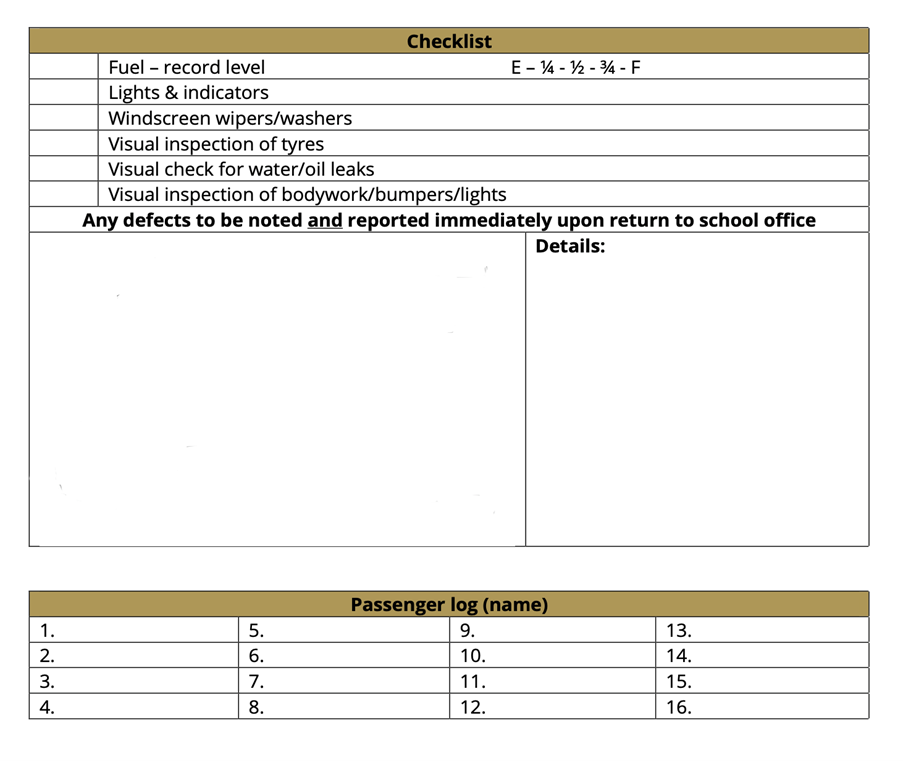
Electric vehicle checklist

Appendix 5 - Emergencies

Breakdown and evacuation procedures

  • The driver has the responsibility for the evacuation of the vehicle.

  • Remember that a very ill passenger or driver would be considered an emergency, enabling you to stop on the hard shoulder of a motorway if necessary.

  • Evacuate to a safe place, control the evacuation, ensuring passengers do no stray in to oncoming traffic.

  • Move the passengers to a place of safety aware from the road and call the emergency services.

  • Once everyone is accounted for and the emergency services are informed, the NEXT CALL should be made to the school.

  • Do not attempt to extinguish fires until the vehicle is clear of all occupants.