Role/Organisation | Name | Contact Details |
Tanfield School Designated Safeguarding Lead (DSL) | Mr C Jones | 01207 232881 |
Tanfield School Deputy Designated Safeguarding Lead (DSL) | Mrs S Douglas | 01207 232881 |
Tanfield School Headteacher (Allegations Management) | Mr S Clough | 01207 232881 |
Tanfield School Health & Safety Officer | Mr G Smith | 01207 232881 |
Named Governor with responsibility for safeguarding | Mr P Ensell | 01207 232881 |
Tanfield School Chair of Governors | Miss C McGough | 01207 232881 |
Eden Learning Trust CEO | Mr K Brennan | 01740 651554 |
Local Authority Designated Officer (LADO) | 03000 268835 | |
First Contact Durham | 03000 267979 | |
Department for Education Extremism Helpline (non-emergency) | 02073 407264 | |
Confidential anti-terrorist hotline | 0800 789 321 | |
Emergency services | 999 | |
NHS Direct | 111 | |
Police (non-emergency) | 101 | |
NSPCC Whistleblowing advice line | 08000 280285 | |
Crisis CAMHS Durham | 08000 516171 |
Safeguarding Policy
Safeguarding
Table of Contents
1. Key Contacts
2. Safeguarding and Child Protection Training Summary
Our school complies with the advice laid down in ‘Working Together to Safeguard Children’ 2023 and ‘Keeping Children Safe in Education’ September 2025 to undertake regular training.
A record of those trained may be found in Every and certificates are kept, where appropriate, to verify the attendance of individuals. Child protection and safeguarding training form a key part of our induction processes. All staff will receive regular updates regarding child protection and safeguarding, including online safety, as necessary and at least annually.
Training for the designated safeguarding lead and other designated teachers in school is also undertaken regularly, and updated at least every two years.
We recognise that, as a minimum, schools should also ensure that the Designated Safeguarding Lead undertakes Prevent awareness training and is thus able to provide advice and support to other members of staff on protecting children from the risk of radicalisation (The Prevent duty DFE 2023).
Name | Training | Date | |
Designated Safeguarding Lead | Mr C Jones | DSL Training Prevent, CSE, FGM, Child Criminal Exploitation (Incl County Lines), Child on Child Abuse, Online Safety | 5th July 2023 Jul 2025 |
Deputy Designated Safeguarding Lead(s) | Mrs S Douglas | DSL Training Prevent, CSE, FGM, Child Criminal Exploitation (Incl County Lines), Child on Child Abuse, Online Safety | 5th July 2023 July 2025 |
Pastoral Safeguarding Team (Assistant Designated Safeguarding Leads) | Mr M Smith Mr G Davison Mr G Parker Mrs H Johnson Mrs M Farrell Mrs V Elliott Mrs C Dalglish | DSL Training Prevent, CSE, FGM, Child Criminal Exploitation (Incl County Lines), Online Safety | June 2024 |
Nominated Governor for Child Protection and Safeguarding | Mr P Ensell | Safeguarding Induction KCSIE update Regular safeguarding training, including Online Safety | 1st Sept 2024 |
Governor(s) and Staff with Safer Recruitment Training | Mrs C McGough Mr C Smith Mr S Clough | Safer Recruitment and refresher training | January 2024 |
Whole Staff & Governors | See separate signed list | KCSIE Update Safeguarding Induction Regular Safeguarding Training, including Online Safety | 1st Sept Sept 2025 |
Local Authority Designated Officer (LADO): Sharon Lewis / Louise Brookes 03000 268835 First Contact Service: 03000 26 79 79 | |||
3. Principles of the policy
This policy operates in conjunction with a range of other policies and documents, including the ones listed below:
Attendance Policy
Anti-Bullying Policy
Behaviour Policy
CIC/PCIC Policy
Equalities Policy
Health and Safety Policy
Job descriptions/role of the designated safeguarding leads
Low Level Concerns Policy
Medications in Schools/First Aid Policies
Online Safety Policy
PSHE policy
Policy on de-escalation and physical restraint of children/pupils
PREVENT documentation (see Appendix 2)
Remote Education Policy
Recruitment and selection policy
RSCE Policy
School Visits Policy
Staff Code of Conduct
Vetting Policy
4. Safeguarding and Child Protection Training Summary
Our school complies with the advice laid down in ‘Working Together to Safeguard Children’ 2023 and ‘Keeping Children Safe in Education’ September 2025 to undertake regular training.
A record of those trained may be found on staff files and certificates are kept, where appropriate, to verify the attendance of individuals. Child protection and safeguarding training form a key part of our induction processes. All staff will receive regular updates regarding child protection and safeguarding, including online safety, as necessary and at least annually.
Training for the designated safeguarding lead and other designated teachers in school is also undertaken regularly and updated at least every two years.
We recognise that, as a minimum, schools should also ensure that the Designated Safeguarding Lead undertakes Prevent awareness training and is thus able to provide advice and support to other members of staff on protecting children from the risk of radicalisation (The Prevent duty DFE 2023).
Name | Training | Date | |
Designated Safeguarding Lead | Chris Jones | DSL Training Prevent, CSE, FGM, Child Criminal Exploitation (Incl County Lines), Online Safety | September 2023 |
Deputy Designated Safeguarding Lead(s) | Sarah Douglas | DSL Training Prevent, CSE, FGM, Child Criminal Exploitation (Incl County Lines), Online Safety | September 2023 |
Safeguarding Team Safeguarding Leas | Matt Smith Graeme Davison Grant Parker Helen Johnson Marie Farrell Vicky Elliott Claire Dalglish | DSL Training Prevent, CSE, FGM, Child Criminal Exploitation (Incl County Lines), Online Safety | September 2023 |
Nominated Governor for Child Protection and Safeguarding | Paul Ensell | Safeguarding Induction KCSIE update Regular safeguarding training, including Online Safety | June 2024 |
Governor(s) and Staff with Safer Recruitment Training | Cristine McGough Michal Scholey Paul Ensell | Safer Recruitment and refresher training | June 2023 |
Whole Staff & Governors | See separate signed list | KCSIE Update Safeguarding Induction Regular Safeguarding Training, including Online Safety | 1st September 2025 |
Local Authority Designated Officer (LADO): Sharon Lewis / Louise Brookes 03000 268835
First Contact Service: 03000 26 79 79 | |||
A. PRINCIPLES OF THE POLICY
Children maximise their potential in an environment which is safe, secure and supportive of all their needs, including any needs they have for protection from abuse.
Our school is committed to promoting the welfare of all children by working in partnership with parents and carers, the Local Authority (LA) and multi-agency partners in early help and child protection, in accordance with locally agreed multi-agency safeguarding arrangements, procedures and practices.
Our policy applies to members of the school community in its widest sense. Thus, this includes children and young people, their parents/carers, school staff, governors, visitors, specialist staff, and the local and wider community where they interface with the school. Within its framework, the policy outlines entitlements and responsibilities in securing the protection of children who attend the school.
Our policy is underpinned and shaped by legislation and guidance contained in a variety of documents including: -
The Children Act 1989; Children Act 2004
The Education Act 2002; Education and Inspections Act 2006
Working Together to Safeguard Children December 2023
Local Multi-Agency Safeguarding Arrangements and Procedures
What to do if you’re worried a child is being abused – DfE 2015
Keeping Children Safe in Education. Statutory guidance for schools and colleges. September 2025
Use of reasonable force. Advice for head teachers, staff and governing bodies. DfE. July 2013
Use of reasonable force in schools - GOV.UK (July 2013)
Information Sharing Agreement: County Durham Safeguarding Adults Inter-Agency Partnership
Procedures for locating missing pupils and the removal of pupils from roll
.Prevent Duty Guidance for England and Wales: HM Government 2023
The Prevent Duty – An introduction for those with safeguarding responsibilities - Updated 2023
Relationships and Sex Education (RSE) and Health Education (until 31st August 2026)
To emphasise the caring ethos of our school, the staff and governors are committed to the following principles: -
The welfare and well-being of each child is of paramount importance.
We recognise our policy works on the premise that abuse takes place in all communities and that school staff are particularly well-placed to identify and refer concerns and to act to prevent children and young people from being abused.
We respect and value each child as an individual.
We are a listening school, and encourage an environment where children feel free to talk, knowing that they will be listened to.
The protection of children from abuse is a whole-school issue, and the responsibility therefore of the entire school community.
We recognise our policy should be accessible in terms of understanding and availability. Regular training will ensure all adults in school are aware of indicators of concern or abuse and colleagues that act as designated safeguarding leads to whom such information should be promptly passed.
Our policy will be developed and kept up to date with information from our relevant partners in early help and child protection, as well as national documentation issued by HM Government and The Department for Education.
We will use the school curriculum to resource our children to protect themselves from abuse, both as victims and as potential perpetrators.
The school runs in an open, transparent way.
We ensure that school leaders, including governors, exercise strategic oversight of all aspects of safeguarding through; training, monitoring visits from link governors, HT’s report to governors & Trust Board, Report to Pupil Welfare Committee and an annual safeguarding audit from Safeguarding provider Clennell Education Solutions
THE FIVE MAIN ELEMENTS TO THE POLICY
(1) Establishing a safe environment in which children can learn and develop
KCSIE September 2025 (para 345) states that ‘Good safeguarding requires continuing commitment from governing bodies, proprietors, and all staff to ensure the safety and welfare of children is embedded in all of the organisation’s processes and procedures and consequentially enshrined in its ethos’.
Establishing a safe environment links to the school’s overall safeguarding arrangements and duty of care to all students.
Use of our school for non-school activities:
Where we hire or rent out our school facilities/premises to organisations or individuals we will ensure that appropriate arrangements are in place to keep children safe in line with Keeping Children Safe In Education September 2025 (paras 166 & 167):
We will seek assurance that the provider has appropriate safeguarding and child protection policies and procedures in place;
We will ensure that arrangements are in place for the provider to liaise with us on these matters where appropriate, whether the children who attend are on our school roll or not;
As a condition of use, these safeguarding requirements will be included in any transfer of control agreement and failure to comply will lead to termination of the agreement.
We will expect providers to have the safeguarding arrangements set out in the following guidance in place: Keeping children safe in out-of-school settings - GOV.UK (www.gov.uk)
Pupils Arriving and Leaving School on Local Authority Arranged Transport
We will inspect a sample of the badges of the drivers and PAs operating transport arranged by Integrated Passenger Transport Group periodically, to check the necessary badges are held and displayed. Any concerns or discrepancies will be reported as soon as possible to IPTG Monitoring team (IPTMonitoring@durham.gov.uk ). We will retain a record of the inspection and outcome to demonstrate these actions.
(2) Ensuring we practice safe recruitment in checking the suitability of staff and volunteers to work with children
Staff and governors who have received Safer Recruitment training are listed in the appendix this document.
Our school will comply with the requirements outlined in local multi-agency safeguarding arrangements ‘Key Safeguarding Employment Standards’ and in the DSCP Child Protection procedures as well as national documentation in ‘Keeping Children Safe in Education’ September 2025.
Our school will refer to its responsibilities regarding safeguarding and child protection in all adverts, job descriptions, and/or to its profile in the school, in the general information distributed with application forms. Annex C in ‘Keeping Children Safe in Education’ September 2025 has specific details of the role of the designated safeguarding lead.
Our school will adhere to The Rehabilitation of Offenders Act 1974 (amended 2020) and the Exceptions Order 1975 taking account of any declarations at the point of interview and not during shortlisting from application.
Our school will undertake appropriate pre-employment checks, including online searches, on all staff working in school, including criminal record checks (DBS checks), barred list checks and prohibition checks together with references and interview information, as detailed in Part Three: Safer Recruitment in ‘Keeping Children Safe in Education’, September 2025. We will also ensure that relevant staff are made aware of their responsibilities to disclose anything relating to “Disqualification Under the Childcare Act 2006” Disqualification under the Childcare Act 2006 - GOV.UK (www.gov.uk)
We will follow good practice advice and inform shortlisted candidates that online searches will be carried out.
As outlined in ‘Keeping Children Safe in Education’, September 2025 (paras 242-253) the level of DBS certificate required, and whether a check for any prohibition, direction, sanction, or restriction is required, will depend on the role that is being offered and duties involved. As most staff will be engaging in regulated activity, an enhanced DBS certificate which includes barred list information, will be required for most appointments. Risk assessments will be undertaken to determine the level of checks needed for any volunteers within our school (KCSIE 2025, paras 309-313).
In our school:
Volunteers will not be left unsupervised with groups of children, nor will they be in areas where they cannot be fully seen by the supervising teacher.
In accepting the offer of help from volunteers, especially those unknown, staff are aware that schools in general are attractive places for ‘unsafe’ volunteers.
Schools may be places where those with unhealthy interests in children seek to find employment (paid or otherwise). We will be vigilant about all inappropriate behaviour with children that gives cause for concern. The Head Teacher and governors are aware of the Durham County Council Confidential Reporting Code arrangements.
We ensure that appropriate DBS checks are carried out before employing supply staff. We will obtain written notification that the appropriate checks have been completed. We will also check that the member of supply staff is the same person for whom these checks have been made.
Our Governing Board will be aware of their responsibilities in connection with staff appointments and similarly aware of their liabilities especially if they fail to follow LA guidance.
·Members of our Governing Board will have an enhanced DBS check. They will also be subject to a Section 128 check.
Volunteers and helpers will not be given tasks beyond their capabilities and therefore where they might feel under pressure.
Volunteers and helpers should feel able to discuss difficulties with the teacher, who will respond with advice and additional guidance and supervision.
Volunteers and helpers will not have the opportunity to feel that they are in charge and thus in a position of power, which may then be abused.
Volunteers, helpers and staff new to the school are given documentation that covers behaviour guidelines for staff and volunteers.
Alternative Provision (KCSIE September 2025 Para 169-171 & 331):
Where we place a pupil with an alternative provision provider (AP Provider), we will understand that we continue to be responsible for the safeguarding of that pupil & will ensure that we are satisfied that the provider can meet the needs of the pupil by:
Obtaining written confirmation from the AP Provider that appropriate checks have been carried out on individuals working at the establishment.
Including written confirmation that the alternative provider will inform us of any arrangements that may put the child at risk (i.e. staff changes), so that we can ensure ourselves that appropriate safeguarding checks have been carried out on new staff.
We will always know where a child is placed in Alternative provision during school hours to provide assurances that the child is regularly attending, and the placement continues to be safe and meet the child’s needs:
We will have records of the address of the alternative provider and any subcontracted provision or satellite sites the child is attending.
We will regularly review the alternative provision placements
Our reviews will be frequent (at least half termly)
Where a safeguarding concern arises, the placement will be immediately reviewed, and terminated, if necessary, unless or until those concerns have been satisfactorily addressed.
The department has issued two pieces of statutory guidance to which commissioners of Alternative Provision should have regard:
• Arranging Alternative Provision - guide for LAs and schools and
• Arranging education for children who cannot attend school because of health needs- (www.gov.uk) - DFE statutory guidance.
(3) Training and supporting staff to equip them to appropriately recognise, respond to and support children who are vulnerable and may need safeguarding
To ensure that we train and support our staff to be equipped to recognise, respond to and support children who are vulnerable and may need safeguarding, we will include:
Creating the right culture and environment so that staff feel comfortable to discuss matters both within and outside (including online) the workplace.
The child protection policy which, amongst other things, also includes the policy and procedures to deal with child-on-child abuse.
The behaviour policy (which includes measures to prevent bullying, including cyberbullying, prejudice-based and discriminatory bullying, including LGBT+). This policy takes the ‘Behaviour in Schools Guidance February 2024’ into account. Behaviour in schools - GOV.UK (www.gov.uk)
The staff code of conduct policy (sometimes called a staff behaviour policy).
The safeguarding response to children who go missing from education.
The role of the designated safeguarding lead (including the identity of the designated safeguarding lead and any deputies).
Copies of policies and a copy of Part One of Keeping Children Safe in Education, September 2025 will be provided to staff and volunteers at induction. All staff, volunteers and supply staff are required to read this.
All staff, volunteers and supply staff will be made aware of:
Our local ‘early help’ process and their role in it.
The process for making referrals to Children’s Social Care and sections 17 and 47 that may follow a referral, along with the role they may be expected to play in such assessments.
What to do if a child tells them he or she is being abused or neglected, along with maintaining an appropriate level of confidentiality, involving only those who need to be involved, and never promising a child that they will not tell anyone about their abuse.
The practical government guidance document ‘Guidance for safer working practice for those working with children and young people in education settings’, Safer Recruitment Consortium, Feb 2022. Professional and Personnel Relationships Home(saferrecruitmentconsortium.org)
All adults working in school will receive annual safeguarding and child protection training which is regularly updated. The DSL is responsible for ensuring that the training reflects new priorities and concerns within the County and other multi-agency local priorities. Adults will also receive updated training and guidance throughout the year as necessary.
The date and the names of delegates at these sessions are recorded and held securely to ensure all staff are appropriately trained.
Staff responsible for safeguarding
Our Designated Safeguarding Lead and deputies will be given sufficient time and training to provide them with the knowledge and skills required to carry out their roles. This will be updated every two years and a record of this training will be kept. In addition to this formal training, their knowledge and skills will continually be updated through a range of means (for example via e-bulletins, attendance at safeguarding networks or through reading), at regular intervals, and at least annually, to keep up with any developments.
(4) Raising awareness of other safeguarding issues, boosting resilience and equipping children with the skills needed to keep them safe
We raise other related issues with children, young people and their parents/carers in the following ways:
Children and Young People
We are mindful that children are kept safe from terrorist and extremist material when accessing the internet in schools. Tanfield School uses Smoothwall filtering and monitoring system which is in place for this and other potentially risky content. Our named member of SLT will review these records regularly to see whether it links up with other safeguarding concerns about particular individuals. Online safety is continually emphasised in line with of Keeping Children Safe in Education, September 2025 and DfE ‘Teaching Online Safety in Schools’, January 2023. Teaching online safety in schools - GOV.UK (www.gov.uk)
Other themes are addressed through our school curriculum, policies, PSHE, RSE and Health Education programmes, assemblies, outside visitors and trainers. These may be part of our typical, planned curriculum or in response to issues arising in school, the community or nationally.
Names (and photographs) of staff and adults will be on display in school that children can speak to if they have concerns (school, family or community issues).
Parents/Carers
Our school brochure, web site and other means of communication with parents will reinforce the message that our school is committed to the welfare and protection of all children in its care. School staff and governors take this duty of care very seriously.
Newsletters, letters to parents about specific issues, our school web site and parents’ evenings / consultations are used to disseminate and reinforce key safeguarding and child protection information.
In addition, we also offer events/briefings and workshops that they may attend on particular issues.
Parents are told that it is essential that school records are kept up to date. Parents are asked to keep school informed of any changes. School will accordingly update records held to reflect:
current address and telephone contacts. We are aware that, as a school, it is good practice to hold more than one emergency contact number for each child, and this is particularly important for children who are a safeguarding or welfare concern
which adults have parental responsibility
court orders which may be in force
children on the Child Protection list
the child’s name at birth and any subsequent names (taking care over unusual spellings)
any other changes to home circumstances
Parents have also been consulted on our RSHE policy.
(5) Developing and implementing procedures for identifying and reporting cases, or suspected cases, of abuse
The culture of our school is that ‘it could happen here’. Staff are trained to identify indicators of abuse and are aware of circumstances that could potentially make children and young people more vulnerable to abuse.
Listening to Children and Receiving Disclosures
We embrace our role as a listening school where children can discuss concerns with any member of staff or adult who works with them. Staff (teaching and support) will make time and be available should children approach them with a situation they are worried about.
Concerns must be taken seriously and at face-value. It is easy to make speedy judgements based on previous knowledge of the child or young person.
Staff receiving a disclosure are unable to promise ‘keeping a secret’ or confidentiality. They will need to explain that depending on what the child says they might need to share the information with someone who deals with these concerns in school.
If the child does not wish to continue and say anything further the adult should pass on the concern to the designated safeguarding lead that might wish to keep an eye on that student and may well be aware of other issues of concern.
‘Staff should never promise a child that they will not tell anyone about a report of any form of abuse, as this may ultimately not be in the best interests of the child.
All staff should be able to reassure victims that they are being taken seriously and that they will be supported and kept safe. A victim should never be given the impression that they are creating a problem by reporting abuse, sexual violence or sexual harassment. Nor should a victim ever be made to feel ashamed for making a report.’ Keeping Children Safe in Education, September 2025, Part One (paras 15-16).
When the member of staff next comes across the child concerned, it would be appropriate to ask how they are and remind them that they are able to come and talk when they wish.
Staff should never speak to another sibling in the family to make enquiries; to investigate concerns is not the role of the school and parents/carers would be rightly aggrieved.
Recording concerns
ALL concerns and disclosures passed to the designated safeguarding lead must be recorded on the school’s Child Protection electronic monitoring system – (CPOMs) or written, signed and dated on the relevant ‘Concern’ form (a hard copy can be found at main reception) All concerns recorded should be factual; staff should avoid using emotive language and recording their opinions.
Staff should write the exact words used by the child. Any original notes/jottings/reminders made by the adult must be stapled to the form as first-hand information that could be important if a case went to court or scanned into the electronic monitoring system.
The more relevant details staff document, the better (eg: approximate size, colour of injury, which arm, if burn is scabbing over etc.) Staff can express concern about an injury (open ended questions) but should not ask direct questions. They should never do so in front of other children.
Please remember: (I) The child should be allowed to make the disclosure at his/her own pace and in his/her own way. (ii) The member of staff should avoid interrupting except to clarify what the child is saying but (iii) Should not probe for any information that the child does not volunteer. |
Concerns about staff members or other adults in school
If there is concern about another member of staff or adult working in school, the matter must be passed straight to the Head Teacher or Head of School in his absence. The member of staff concerned must not be spoken to. If the concern regards the Head Teacher, this should be passed onto the Chair of Governors. Further information is included in Section G of this policy and KCSIE 2025, Part Four.
Recording and Response of the designated lead professional
All information received is stored securely in electronic or paper form. We provide appropriate levels of access to information. Paper records are kept securely in locked storage and away from the child’s individual school records. (The child’s individual file is marked to show the existence of the additional ‘concern’ file). Our designated safeguarding leads can access these documents in an emergency or in the event of an enquiry for information by the MASH (Multi-Agency Safeguarding Hub) Team, for example.
We keep a ‘chronology of significant events’ for all children causing concern in school, in the event that the MASH make contact about issues beyond school and inform any other concerns in school.
We ensure that records include:
a clear and detailed summary of the concern
details of how the concern was followed up and resolved
notes of any actions taken, decisions reached and the outcome
Discussing concerns with the First Contact Service –
03000 26 79 79
We use the local authority Referral Form for notifying First Contact of concerns. Early help referrals are completed online using the following link: https://doitonline.durham.gov.uk/service/Early_Help_Referral via DCC CRM system.
Procedures and guidance detailing local multi-agency arrangements, including detailed information about the management of individual cases, may be found at www.durham-scp.org.uk
If a concern is taken up as a referral under section 47: Child Protection, actual or likelihood of significant harm, parents or carers will be informed of this unless to do so would place the child at further risk of harm.
If the child requires immediate medical attention, staff will accompany the child to the nearest Accident and Emergency Department. First Contact will be informed immediately if the injuries are linked to a child protection matter, so an appropriate paediatrician sees the child. The Director of Children and Young People’s Services will be informed, and parents will be notified of the action taken.
If the situation is an emergency and staff are unable to speak to First Contact, we will phone the Police on 101 and ask to speak to a colleague in the Vulnerability Unit concerning a child.
Police Switchboard: 0345 6060365 or 101 Ask for the nearest local Vulnerability Unit to school |
Discussions with First Contact will be followed up in writing
Discussions of concern and requests for support will be followed up in writing, using the referral form. Early help referrals are completed online using the following link: https://doitonline.durham.gov.uk/service/Early_Help_Referral via DCC CRM system. A copy is kept on the child’s concern file.
If a member of staff feels that the designated safeguarding lead and/or Head Teacher are not taking concerns seriously enough, then it is appropriate for them to tell that person that they are going to consult with First Contact themselves.
Any staff member who has a concern about a child’s welfare should follow the referral processes set out in Keeping Children Safe in Education 2025, Part One.
First Contact Service Telephone: 03000 26 79 79 |
Attendance at Strategy meetings if assessed to be child protection concern
Strategy meetings are one of four multi-agency meetings as part of Child Protection processes. Local multi-agency procedures have detailed guidance about these meetings www.durham-scp.org.uk
The threshold document is available on the DSCP website.
School staff may be invited to a strategy meeting. These multi-agency meetings are called to decide whether the threshold for an s47 enquiry should commence to investigate the concerns that have been raised.
These meetings may be called at short notice and appropriate staff from school will attend wherever possible. If the school is the referring agency, they should be invited to attend these meetings.
Staff will make available any electronic forms or handwritten notes, dated and signed, as well as other records from the concern file including the single agency chronology of concerns. Any further written evidence from the child: stories, drawings etc. will be brought to the meeting.
In school, staff will monitor the child discreetly for any further concerns or signs that are worrying, maintain appropriate records and give support and reassurance to the child.
All information should be treated with discretion and confidentiality and shared in accordance with the National Guidance on information sharing and the GDPR and Data Protection Act 2018.
If concerns are not substantiated following the section 47 enquiries, our school will work with other agencies to determine what further support the family and child require. The school will continue to monitor and support the child.
B. OVERVIEW: SAFEGUARDING
(1) What school staff should know and do: A child centred and coordinated approach to safeguarding.
‘Keeping Children Safe in Education 2025’ states safeguarding and promoting the welfare of children is everyone’s responsibility:
‘protecting children from maltreatment, preventing the impairment of children’s mental and physical health or development, ensuring that children grow up in circumstances consistent with the provision of safe and effective care; and taking action to enable all children to have the best outcomes. 'Children' includes everyone under the age of 18.’ (paras 2)
(2) Safeguarding within this school
Everyone who encounters children, and their families has a role to play in safeguarding children. School staff are particularly important as they can identify concerns early and provide help for children, to prevent concerns from escalating. Schools and their staff form part of the wider safeguarding system for children by working with our 3 safeguarding partners in Durham Safeguarding Children Partnership – Durham County Council, Durham Constabulary, and the Clinical Commissioning Groups to promote the welfare of children and protect them from harm.
Safeguarding children permeates all aspects of our work as a school, with a preventative role to inform and boost the resilience of all students by enhancing protective factors in their lives.
Accordingly, this policy links with many other related policies in school listed on page one of this policy.
This policy is also linked to local multi-agency safeguarding arrangements. Current, up to date documentation can be found at Durham Safeguarding Children Partnership (durham-scp.org.uk) and include:
Managing Allegations against Staff (Durham online local partnership safeguarding arrangements and policies)
County Durham Practice Framework: Single Assessment Procedure & Practice Guidance.
Keeping Children Safe in Education. September 2025
(3) Safeguarding throughout school life
Caring ethos
We aim to create and maintain a caring ethos where all children and adults feel safe, secure and valued. If children feel happy and enjoy school this will encourage good attendance and then create conditions in which they can do their best in every area of school life. Our school operates as a listening school where children can approach adults with concerns. These will be taken seriously and relevant local multi-agency safeguarding procedures followed without delay if there is a risk/likelihood of, or actual significant harm.
Curriculum
Children have access to an appropriate curriculum, including the teaching of RSE and Health Education, differentiated to meet their needs. This enables them to learn to develop the necessary skills to build self-esteem, respect others, defend those in need, and resolve conflict without resorting to violence. Children learn skills to question and challenge to enable them to make informed choices now and later in life. A protective factor for children is personal resilience including strong social and emotional skills. All work with children which boosts confidence and self-esteem is valuable to protect them from peer pressure and outside influences detrimental to their physical and mental well-being.
Children are encouraged to express and discuss their ideas, thoughts, and feelings through a variety of activities and have access to a range of cultural opportunities which promote respect and empathy for others. As part of our Prevent duty under s.26 of the Counterterrorism and Security Act 2015, we are aware of the importance of building pupils’ resilience to radicalisation by promoting fundamental British values and enabling them to challenge extremist views. Schools can build pupils’ resilience to radicalisation by providing a safe environment for debating controversial issues and helping children and young people understand how they can influence and participate in decision-making.
Many areas of the curriculum include age-appropriate opportunities for children and young people to discuss and debate important issues including lifestyles, health, safety, and well-being (physical and emotional), family life, child-care, and parenting, forced marriage, domestic abuse, religious beliefs, and practices as well as human rights issues. Through these, we support children and young people to recognise and manage risk, make safer choices, and recognise when pressure from others threatens their personal safety and wellbeing. They can develop effective ways of resisting pressure, including knowing when, where and how to get help.
Attendance
Working together to improve school attendance
We recognise that improving attendance is everyone’s business. The barriers to accessing education are wide and complex, both within and beyond the school gates, and are often specific to individual pupils and families. Good attendance begins with school being somewhere pupils want to be and therefore the foundation of securing good attendance is that school is a calm, orderly, safe, and supportive environment where all pupils are keen and ready to learn.
Some pupils find it harder than others to attend school and therefore at all stages of improving attendance, schools and partners should work in partnership with pupils and parents collaboratively to remove any barriers to attendance by building strong and trusting relationships and working together to put the right support in place. Securing good attendance cannot therefore be seen in isolation, and effective practices for improvement will involve close interaction with schools’ efforts on curriculum, behaviour, bullying, special educational needs support, pastoral and mental health and wellbeing, and effective use of resources, including pupil premium.
We agree to fulfil our statutory reporting duties around attendance and ensure that
appropriate safeguarding arrangements are in place to respond to children who are absent from education, particularly on repeat occasions and/or for prolonged periods. (KCSiE 2025 para 98 and 177).
Universal services and specialist support staff
The following professionals are also available to support individual children in school:
Stanley One Point Hub 0300 026 1111
The school nurse / Health Visitor
Attendance and Inclusion Officers
Educational Psychologist
Child and Adolescent Mental Health Service (CAMHS)
Inclusion Practitioner
Behaviour Panel
North East Wellbeing Trust
Childcare Arrangements Before and After School (including extra-curricular activities)
Include details regarding:
Morning Mastery
After-school activities on and off site
These all provide further opportunities for students to develop positive and caring relationships with adults, who themselves will be trained to be aware of signs and behaviours that could suggest concerns. Supportive relationships outside the home, such as those with adults in school and other children, are additional protective factors that boost children’s resilience. Staff will always work with children in a professional way and are reminded to respond to disclosures sensitively and appropriately. All adults in school know the names of the designated safeguarding leads and are made aware of their responsibility to pass on any issues of concern without delay and make a written record.
Working with parents and carers
Our school believes in effective communication with parents and carers. We welcome parent/carer views and concerns about the welfare of their children and use this feedback to regularly review our practices. Parental views are obtained in the following ways:
(surveys, questionnaires, Parent’s Evenings etc.)
We keep parents informed about important and topical issues, including child protection elements of safeguarding, in the following ways:
(Newsletters, social media, letters home, website, training/information sessions e.g. e-safety, bullying etc.)
We aim to have good working relationships with parents and carers and to work in partnership with them through transparency and honesty. However, we do not forget that their child’s needs and welfare are our paramount concern, thus obtaining consent to take matters further is not always appropriate. This obligation is set out in our school prospectus/brochure.
C. CHILD PROTECTION WITHIN SAFEGUARDING ARRANGEMENTS FOR ALL CHILDREN/YOUNG PEOPLE IN SCHOOL
There are a series of layers of care and intervention ranging from safeguarding for all/universal services (single-agency activities) through to multi-agency work under the Children’s Act 1989 and its amendments:
Safeguarding arrangements in school
Early Help within universal services
More complex cases requiring Early Help
Child in Need consent required as for Levels 2 and 3
Child Protection
Durham Safeguarding Children’s Partnership guidance and procedures (see Durham Safeguarding Children Partnership)
The Growing Up in County Durham Strategy
The Growing Up in County Durham Strategy was prepared jointly by all public services, voluntary and community services, including the Council, local health services and the police who work together to improve outcomes for children, young people and their families through the Children and Families Partnership. It can be accessed here: https://countydurhampartnership.co.uk/health-wellbeing-board/growing-up-in-county-durham-strategy/
(1) Life at Home
The Framework for Assessment triangle, reproduced below, summarises every aspect of a child’s life under three headings and is mirrored in the Referral form for First Contact Service.
Child’s developmental needs (How I grow and develop)
Parenting capacity (What I need from people that look after me)
Family and environmental factors (My wider world)
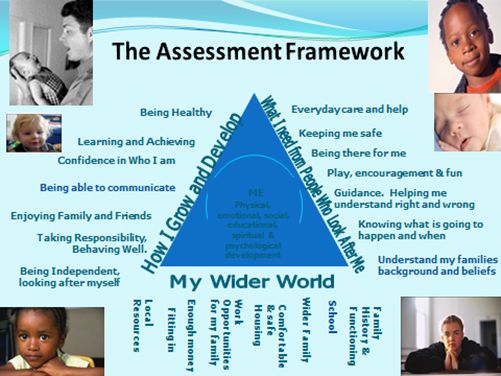
Aspects from all three domains combine in home life and staff and adults in school should be mindful of these connections as they work with children and their parents/carers in school.
This school believes that it is essential to work with parents and carers in the best interests of their children. However, good relationships with parents and carers should not detract from our primary concern which is the welfare of children in this school.
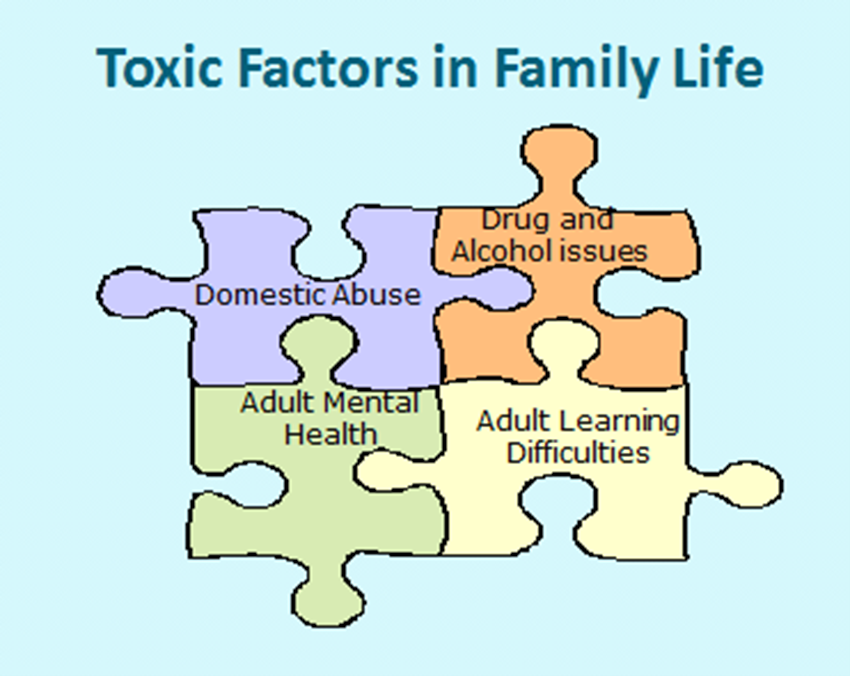
Staff are made aware in training of the ‘toxic quad.’ issues in home life that could have an impact on the way children are parented (Munroe, 2010). The Government research into Serious Case Reviews reveals that the presence of one or more of the following issues could have a detrimental impact on parenting of children in that household:
Domestic abuse (violence)
Substance misuse (alcohol and or drugs)
Adult mental health
Learning Disabilities
Neglect is the largest category for children being on the Child Protection list (nationally and in Durham). Durham DSCP have produced Neglect Practice Guidance. It can be found within the County Durham Children and Families Practice Toolkit here: County Durham Children & Families Practice Toolkit (durham-scp.org.uk)
(2) Signs and behaviours of concern
All of our staff are familiar with KCSIE September 2025 and their responsibilities highlighted within this (paras 18 to 55).
All staff, but especially the designated safeguarding lead (and deputies) should consider whether children are at risk of abuse or exploitation in situations outside their families. Extra familial harms take a variety of different forms and children can be vulnerable to multiple harms including (but not limited to) sexual abuse (including harassment and exploitation), domestic abuse in their own intimate relationships (teenage relationship abuse), criminal exploitation, serious youth violence, county lines and radicalisation. Keeping Children Safe in Education, September 2025, Part One (para 21).
Paragraph 18 of the document emphasises that staff should be particularly alert to the need for early help for the following groups of children:
is disabled or has certain health conditions and has specific additional needs
has special educational needs (whether or not they have a statutory
Education, Health and Care plan)
has a mental health need?
is a young carer
is showing signs of being drawn in to anti-social or criminal behaviour,
including gang involvement and association with organised crime groups or
county lines
is frequently missing/goes missing from education, home or care,
has experienced multiple suspensions, is at risk of being permanently
excluded from schools, colleges and in Alternative Provision or a Pupil
Referral Unit.
is at risk of modern slavery, trafficking, sexual and/or criminal exploitation
is at risk of being radicalised or exploited
has a parent or carer in custody, or is affected by parental offending
is in a family circumstance presenting challenges for the child, such as drug
and alcohol misuse, adult mental health issues and domestic abuse
is misusing alcohol and other drugs themselves
is at risk of so-called ‘honour’-based abuse such as Female Genital
Mutilation or Forced Marriage
is a privately fostered child.
All staff should receive appropriate safeguarding and child protection training (including online safety which, amongst other things, includes an understanding of the expectations, applicable roles and responsibilities in relation to filtering and monitoring – see para 140 for further information) at induction. The training should be regularly updated. In addition, all staff should receive safeguarding and child protection (including online safety) updates (for example, via email, e-bulletins, and staff meetings), as required, and at least annually, to continue to provide them with relevant skills and knowledge to safeguard children effectively. Keeping children safe in education, September 2025, Part One (para 12).
In our school we do these regular updates through:
safeguarding bitesize documents, staff briefings, notice-boards etc.
Our school understands that it is best practice to discuss concerns with parents/carers before contacting First Contact Service (providing this does not present a delay), unless by doing so the child would be put at further risk of harm. First Contact Service: 03000 267979.
Where a child is suffering, or is likely to suffer from harm, it is important that a referral to children’s social care (and if appropriate the police) is made immediately.
Anyone can make a referral. When referrals are not made by the designated safeguarding lead, the designated safeguarding lead should be informed, as soon as possible, that a referral has been made.
(3) Early Help Assessment Procedure & Practice Guidance
‘All staff should be prepared to identify children who may benefit from early help. Early help means providing support as soon as a problem emerges at any point in a child’s life, from the foundation years through to the teenage years. KCSIE 2025 (para 6). This relates to work with other universal agencies and following DSCP procedures and guidance.
A new Early Help Assessment and Child and Family Plan has been developed by partners, children, young people, parents and carers which will help families get the support they need at the earliest opportunity.
It is much more streamlined, family friendly and signs of safety/wellbeing focussed. The documents can be accessed through the Children's Services Portal
Our school is aware that ‘no single practitioner can have a full picture of a child’s needs and circumstances’. Also, that ‘if children and families are to receive the right help at the right time, everyone who comes into contact with them has a role to play in identifying concerns, sharing information and taking prompt action’. KCSIE 2025 (para 3).
Tanfield school believes that information sharing is a key element when delivering coordinated services for children and young people. It is essential to enable early help and support and for promoting child protection and welfare. Our staff understand when, why and how they should share information so that they can do so confidently and appropriately as part of their day-to-day practice.
Tanfield school works with the consent of parents and carers to jointly undertake assessments where an unmet need has been identified. However, we are aware that it may be necessary to meet with other services and agencies even if this consent for a ‘Team around the Family’ meeting is not forthcoming. These professionals’ meetings are important to share concerns, suggest ways forward along with further work to encourage participation by parents/carers in early help processes One Point colleagues and Early Help Advisers are also a useful source of advice in these circumstances.
Guidance on Early Help in County Durham can be found here: https://durham-scp.org.uk/professionals/early-help/ This includes information on how to make a request for additional early help and provides details of Locality Early Help Conversations.
Professionals can make a request for (additional) early help by completing an on-line Early Help Request Form on the Childrens Service Portal or by telephoning the Early Help Triage Team on 03000 267 979, Option 1, Option 2, Option 4, (Mon – Thurs 08.30 – 17.00, Fri 08.30 – 16.30)
Team around the Family (TAF) is an early means of intervention to provide appropriate advice and support for the parents/carers and young person by working with appropriate local agencies through Team around the Family arrangements.
Durham Multi-Agency Safeguarding Hub (MASH)
Where concerns are identified as amber or red on the MASH Process Pathway, our school will cooperate promptly and fully, with relevant information, to inform further assessments undertaken by the MASH team.
The Extended Role of the Virtual School Head
This is a strategic role. In Durham a team of professionals work together to provide schools with the Vulnerable Pupil lists through the Schools Portal. This includes all children with a social worker currently open to Social Care and those who have been closed in the last six years.
The Virtual Head updates the DSL through DSL Network Meetings. Where attendance is a concern, school will work within the framework of the Attendance Toolkit for CWSW, available on the Schools Portal. The school, by working together with partners aims to achieve the best outcomes for CWSW by identifying and addressing the child’s needs at the earliest opportunity.
KCSIE 2025 extends the duties of the Virtual Head to provide advice to Informal as well as Formal Kinship Carers. The Previous Children in Care Officer can be contacted via DurhamVirtualSchool@durham.gov.uk.
(4) Child in Need
Section 17 of the 1989 Children Act
Working Together to Safeguard Children 2018
“A child in need is defined under the Children Act 1989 as a child who is unlikely to achieve or maintain a reasonable level of health or development, or whose health and development is likely to be significantly or further impaired, without the provision of services; or a child who is disabled. Local authorities are required to provide services for children in need for the purposes of safeguarding and promoting their welfare. Children in need may be assessed under section 17 of the Children Act 1989” KCSIE 2025 (para 60).
This school recognises the importance of early support and intervention work in more complex cases, undertaken with the consent of parents and carers, and follows the Threshold Guidance document which sets out local criteria for action and includes links to additional information which may assist professional judgement in understanding and subsequently meeting a child and family's needs. DSCP toolkits and guidance (including the Threshold Guidance) can be found here
(5) Child Protection and Significant Harm
Section 47 of the 1989 Children Act
Working Together to Safeguard Children 2018
‘Local authorities, with the help of other organisations as appropriate, have a duty to make enquiries under section 47 of the Children Act 1989 if they have reasonable cause to suspect that a child is suffering, or is likely to suffer, significant harm. Such enquiries enable them to decide whether they should take any action to safeguard and promote the child’s welfare and must be initiated where there are concerns about maltreatment. This includes all forms of abuse, neglect and exploitation.’ KCSIE 2025 (para 61)
Significant harm is where some children are in need because they are suffering, or likely to suffer, significant harm. This is the threshold that justifies compulsory intervention in family life in the best interests of children.
(6) Prepare for the unexpected
Our staff are aware from their training that some children might display worrying signs/symptoms or disclose information suggesting abuse, when they have never previously given rise to concern. Staff must contact the designated safeguarding lead for child protection without delay so concerns can be discussed with First Contact Service as soon as possible. In all cases, it should be borne in mind that other siblings might be at risk in the household as well as the one presenting concerns in school.
‘Staff working with children are advised to maintain an attitude of ‘it could happen here’ where safeguarding is concerned. When concerned about the welfare of a child, staff should always act in the best interests of the child’. KCSIE 2025 (para 49).
(7) Low Level Concerns
Please see: KCSIE 2025 (paras 437 - 449).
As part of our safeguarding culture, ALL concerns regarding adults are shared responsibly in line with our school’s safeguarding reporting systems and will be recorded in writing and held securely in accordance with our Low Level Concerns Policy and Guidance. Records will be reviewed so that potential patterns of concerning, problematic or inappropriate behaviour can be identified, and appropriate actions taken.
We will ensure that:
staff are clear about what appropriate behaviour is, and are confident in distinguishing expected and appropriate behaviour from concerning, problematic or inappropriate behaviour, in themselves and others;
staff know how to share any low-level safeguarding concerns and are empowered to do so;
unprofessional behaviour is addressed, and the individual is supported to correct it at an early stage;
we will provide a responsive, sensitive and proportionate handling of such concerns when they are raised;
we will use concerns to help identify any weakness in the school safeguarding system.
We will instil a culture where staff feel safe to report any concerns using our safeguarding reporting system identified in this policy. We would also encourage the staff member themselves to report any behaviour that could be classed as a low-level concern. Where the report has been made by a third party, as much evidence as possible will be gathered by the head teacher/principal from the person reporting the concern, the individual named and any witnesses. All of this will be recorded to determine whether any further action needs to be taken alongside a recorded rationale as to the decisions taken.
In the case of reports about supply staff and contractors, we will report any concerns to their line managers so that any concerning, problematic or inappropriate patterns of behaviour can be identified.
We will retain information regarding low level concerns in line with our school’s Low Level Concerns Policy. KCSIE 2025, paragraph 444 recommends at least until person leaves school’s employment.
‘…Low-level concerns should not be included in references unless they relate to issues which would normally be included in a reference, for example, misconduct or poor performance. It follows that a low-level concern which relates exclusively to safeguarding (and not to misconduct or poor performance) should not be referred to in a reference. KCSIE 2025, paragraph 445
Please refer to our Low Level Concerns Policy and reporting form.
D. MULTI-AGENCY WORK IN CHILD PROTECTION
See Appendix 1: Summary of multi-agency meetings
For up-to-date school responsibilities and LA arrangements and procedures please see the local partnership website - https://durham-scp.org.uk/practitioners/
(1) Initial Child Protection Conference: school responsibilities
See local partnership procedures for more details, https://durham-scp.org.uk/about-us/multi-agency-safeguarding-arrangements/
Following the final strategy meeting (some complex cases like forced marriage, fabricated and induced illness and organisational abuse may require several strategy meetings) a decision might be made to hold an Initial Child Protection Conference. This work continues within Family First teams within the County.
A conference will be called if there is thought to be an on-going risk or likelihood of significant harm to the child(ren). The date will be within 15 working days after the last strategy meeting.
Attendance at Conference
It is understood that appropriate school staff should make every effort to attend (unless the date coincides with school holidays).
Preparation of a report
Schools would be expected to prepare a report and may wish to amplify and develop information provided on the referral form as the basis of their report. https://durham-scp.org.uk/practitioners/guidance-toolkits-and-forms-for-practitioners/child-protection-conference-report-template/
Chronology of significant events
A single-agency chronology should also be produced for this meeting. The detailed ‘in house’ school chronology should be streamlined to include key relevant incidents noted by school.
Sharing of the report
The report should be shared with parents/carers of the child at least two working days before the conference. Part of the report may also be shared with the young person, where age appropriate. This will give the family a chance to question or clarify any issues raised within the report prior to the conference.
The report will be passed to the Conference Clerk via the e-mail system ready for dissemination to other professionals attending the conference.
(2) Membership of a Core Group
This school recognises that membership of a core group is a responsibility that necessitates time and commitment to attend regular meetings and complete the work detailed in the Child Protection Plan.
The merged multi-agency chronology will be regularly updated as part of this on-going work.
(3) Review Child Protection Conference
The school will complete the relevant report for the first review conference, after 10 weeks and for any subsequent reviews at intervals of 5 months. The report will detail work undertaken by the school with parents/carers and the child to complete the tasks assigned in the Child Protection Plan. This report should be shared 7 days before the conference takes place. This report will detail the progress made towards the tasks outlines on the Child Protection Plan.
E. INFORMATION-SHARING
Staff at our school are aware of the need to share information appropriately. KCSIE 2025 (Paras 114 - 122)
If there are concerns that sharing of information with individuals could result in significant harm to any individual, legal advice should be sought before the information is shared.
Our school takes care to ensure that information about a child is only given to the appropriate external people or agencies. Staff will take names and ring back via a main switchboard if unsure. All staff within school will be aware of the confidential nature of personal information about a child and the need for maintaining confidentiality. They will seek advice about parental responsibility issues if unsure.
Parents/Carers
Where we have concerns about a child’s safety and decide to share information to protect them from harm, we will explain to parent(s) or carer(s), and the child as appropriate, what information we intend to share, with whom and why, wherever it is safe and practical to do so. This is unless there are concerns that seeking to discuss a concern could result in a risk of harm to any individual.
Parents must be aware that once matters have been referred to the First Contact Service the school can only explain the procedure and is not able to give ‘progress reports’ on the case.
School staff
There is a delicate balance to be struck between alerting members of staff to the concern about the child and the need to protect the child from too many people knowing. Information should only be divulged on a ‘need to know’ basis. Other members of staff need to know sufficient detail to prepare them to act with sensitivity to a distressed pupil. They do not need to know details.
Children transferring to another school
Where a child is the subject of a Child Protection Plan and they move to another school, the designated lead professional will inform the new school immediately and arrange the handover of confidential information securely and separately from other records.
If a child for whom there are other existing serious concerns transfers to another school, the new receiving school will be informed immediately, and written records will follow. Both schools should maintain evidence of the secure transfer and receipt of information. Schools that use the same child protection electronic recording system should use this to transfer records securely. (eg. CPOMS)
Data that is not being transferred to another school should be kept in line with the school’s Data Retention Policy, e.g., electively home educated pupils or moving to full time employment.
Guidance and protocols
Please see the following guidance:
‘Information sharing’ on the Durham Safeguarding Children Partnership website
Further advice about legal issues is available from Corporate Legal Services
LegalservicesSLA@durham.gov.uk 03000 266 196
F. ALLEGATIONS AGAINST STAFF AND VOLUNTEERS
See Part Four of Keeping Children Safe in Education 2025, paras 356– 449.
The Durham Safeguarding Children Partnership website provides information about dealing with allegations against staff and volunteers (including supply staff) who have contact with children and young people in their work or activities.
Allegations of abuse by adults and peers in schools must be investigated in accordance with the DSCP procedures, and when dealing with any allegation against adults and peers, it is vital to keep the welfare of the child as the central concern. However, as in all child protection issues, a balance needs to be struck between supporting and protecting the child and keeping the effects of possibly false allegations to a minimum. Thus, urgent consideration should be given to the substance of the allegations.
Receiving an allegation
On receiving an allegation, the Head Teacher will proceed in line with recognised procedures - consulting immediately with LA officers (LADO, Local Authority Designated Officer, see contact details at front of policy) and/or informing the First Contact Service. If the LADO is unavailable there should be no delay in discussing with First Contact. The Head Teacher must not start to investigate.
If an allegation is made for a person not directly employed by the school recognised procedures should be followed. This includes supply staff, sports coaches and any individual or organisation using the school premises for the purposes of running activities for children (for example community groups, sports associations, or service providers that run extra-curricular activities). Under no circumstances should a school cease the use of a supply teacher, sports coach etc. due to safeguarding concerns without liaising with the LADO. (See KCSIE 2025, paras 377 - 380)
Allegations regarding the Head Teacher should be passed to the Chair of Governors. Should this lead to delay, the person receiving details of the allegation should follow the advice above and report the matter immediately to the LADO and First Contact Service. At this stage the Head Teacher should not be informed of the allegation (the same process as for any member of staff or adult in school). The Chair of Governors should be informed as soon as possible and asked to contact the LADO.
Where it is suspected that a crime has been committed, then the matter should be reported to the police with immediate effect.
Local Authority Designated Officer (LADO)
Local Authority Designated Officer (LADO)
Sharon Lewis / Louise Brookes 03000 268835
First Contact Service
03000 26 79 79
Carrying out an investigation
Investigations will be carried out by the appropriate agencies.
In dealing with any allegation the Head Teacher and governors need to balance:
The seriousness of the allegation.
The risk of harm to pupils.
Possible contamination of evidence.
The welfare of the person concerned.
Suspension of the member of staff / adult in school will be considered:
(a) if there are any grounds for doubt as to the suitability of the employee to continue to work
(b) where suspension may assist in the completion of an investigation.
Suspension will be carried out in line with LA / Trust guidelines. Head Teachers should contact Human Resources for guidance. (HRSchools@durham.gov.uk )
Suspension should not be an automatic response. It should only be considered where there is cause to suspect child(ren) is/are at risk of harm or the case is so serious there may be grounds for dismissal. If in doubt, advice should be sought from HR and the LADO. Based on advice and a risk analysis, alternatives may be: redeployment of the individual; providing an assistant to be present when the individual has contact with children; moving the child/children, but only if it is in the best interests of the child, their views have been sought and parents have been consulted. See KCSIE 2025, Part Four, paras 383-390.
During the investigation, support will be offered to both the pupil making the allegation and the adult / peer concerned. The welfare of a child is paramount, and this will be the prime concern, however employers have a duty of care to their employees and should act in accordance with paragraph 391 of KCSIE 2025.
Once Police and Intervention and Assessment teams have decided if further action is necessary or not, a meeting will take place with a representative from the school, LADO and HR to decide next steps and if an internal disciplinary investigation is needed. Paragraphs 409 KCSIE 2025
Recommendations following an investigation
Where recommendations are made to school regarding the outcome of a Child Protection investigation, the school will advise Children and Young People’s Services regarding their response to the recommendation. For example, if a person is suspended and returns to school, the date of that return should be communicated.
The following definitions are now used when determining the outcome of allegation investigations:
Substantiated: there is sufficient evidence to prove the allegation.
Malicious: there is sufficient evidence to disprove the allegation and there has been a deliberate act to deceive or cause harm to the person subject to the allegation.
False: there is sufficient evidence to disprove the allegation.
Unsubstantiated: there is insufficient evidence to either prove or disprove the allegation. The term, therefore, does not imply guilt or innocence.
Unfounded: to reflect cases where there is no evidence or proper basis which supports the allegation being made.
Where it is considered that an individual has engaged in conduct that has harmed (or is likely to harm) a child or if a person otherwise poses a risk to harm a child, the Head Teacher and/or governors will make a referral to the TRA and DBS in line with their legal requirement to do so. (KCSIE 2025 paras 406 & 407)
G. SAFE TOUCH
Physical contact other than to control or restrain
Our school has a policy / guideline on the use of touch, including an Intimate Care policy and this includes such points as:
assisting in the washing of young children who have wet/soiled themselves
intimate care risk assessments for certain children with medical needs or disabilities.
using physical contact to demonstrate exercises or techniques, for example, in PE, sports coaching or other practical subjects.
administering First Aid
supporting younger children and children with special needs who may need physical prompts or help
giving appropriate comfort to a child who is distressed
recognising that physical contact is a sensitive issue for some cultural groups
acknowledging that physical contact becomes increasingly open to question as children reach and go through adolescence
ensuring a consistent approach where staff and pupils are of different genders
acknowledging that innocent and well-intentioned physical contact can sometimes be misconstrued
having a prescribed handling policy for children requiring complex or repeated physical handling, with specific training for staff who deal with them.
I. PHYSICAL CONTROL AND RESTRICTIVE PHYSICAL INTERVENTION: USE OF REASONABLE FORCE
(Paragraph 163-165, KCSIE 2025) Our school has a separate policy on the use of restrictive physical interventions covering the appropriate use of reasonable force that all staff are made aware of and follow.
Our school policy relates to the following: DfE Guidance: Use of Reasonable Force in Schools
Our school Policy on the Use of Restrictive Physical Interventions gives guidance on:
when it is appropriate for staff to use physical control and restraint
who is allowed to use physical control and restraint
what forms of physical control and restraint may take place in particular circumstances
what forms of physical control and restraint are not acceptable
how the additional vulnerability of pupils with SEND, mental health problems or medical conditions will be considered
ensure our duties under the Equality Act 2010 are considered
recording of incidents where physical handling has been used
the Policy also makes it clear that corporal punishment is NOT allowed.
J. THE PREVENT DUTY
(Pages 157 to 159, KCSIE 2025) The Counter Terrorism and Security Act 2015 places a due on certain bodies, including schools, to have ‘due regard to the need to prevent people from being drawn into terrorism’. The DfE has produced non-statutory advice,‘The Prevent Duty: an introduction for those with safeguarding responsibilities’ September 2023.
“Similar to protecting children from other forms of harms and abuse, protecting children from this risk” is a part of our safeguarding approach as it is possible to intervene to prevent vulnerable people being radicalised. We use the above document and advice in the following documents The Prevent duty: safeguarding learners vulnerable to radicalisation - GOV.UK (www.gov.uk) and Managing risk of radicalisation in your education setting - GOV.UK (www.gov.uk) to support us in our work to form risk assessments, working in partnership, staff training, IT policies and building children’s resilience to radicalisation.
In our school:
Staff can identify children who may be vulnerable to radicalisation. Information or concerns are shared with the Designated Safeguarding Lead in the same way as other information that might be a safeguarding concern, who will then follow procedures in line with safeguarding DSCP guidance.
Policies and procedures are in line with those of DCC, Durham Constabulary and the DSCP.
Throughout the life of the school as well as in specific lessons to build pupils’ resilience to radicalisation by promoting fundamental British values and enabling them to challenge extremist views.
Robust online policies are mindful of guidance within Keeping Children Safe in Education, September 2025, DfE guidance ‘Teaching Online Safety in School’ Meeting digital and technology standards in schools and colleges
2023 Prevent Duty Guidance: for England and Wales, paragraph 64, notes ‘Schools should be safe spaces in which children and young people can understand and discuss sensitive topics, including terrorism and the extremist ideas that are part of terrorist ideology, and learn how to challenge these ideas. The Prevent duty is not intended to limit discussion of these issues. Schools should, however, be mindful of their existing duties to forbid political indoctrination and secure a balanced presentation of political issues’
We will follow the County Durham Prevent Referral Flowchart (September 2022, Appendix 2) when any concerns are identified. Through discussion with the specialist colleagues at Durham Constabulary it may be appropriate to make a referral to the Channel programme. This programme focuses on support at an early stage, tailor-made to the individual young person. Engagement with the programme is entirely voluntary. A school representative may be asked to be a member if a student from the school is to be discussed at the Channel panel.
CHILD SEXUAL EXPLOITATION (CSE)
We ensure all of our staff are trained to be aware of young people who could be at risk of sexual exploitation. See Keeping Children Safe in Education, September 2025 (para 38-40).
Refer also to:
Sharing nudes and semi-nudes: advice for education settings working with children and young people
CSE is where an individual or group takes advantage of an imbalance of power to coerce, control, manipulate or deceive a child into taking part in any sexual activity and can be experienced by both boys and girls: It is a form of child sexual abuse.
Sexual abuse may involve both physical and non-contact activities. It can occur over time or be a one-off occurrence. Our staff know that some children may not realise they are being exploited, for example, if they believe they are in a genuine romantic relationship and will handle these situations appropriately.
Durham DSCP has a section of their website devoted to resources, guidance, and a risk assessment matrix that assists schools: Child Exploitation Risk Assessment Information Form (durham-scp.org.uk).
L. FEMALE GENITAL MUTILATION
If there are concerns that an act of FGM has been undertaken on a girl under the age of 18, this MUST be reported to the police immediately.
Whilst all staff should speak to the designated safeguarding lead (or deputy) with
regard to any concerns about female genital mutilation (FGM), there is a specific legal duty on teachers. If a teacher, in the course of their work in the profession, discovers that an act of FGM appears to have been carried out on a girl under the age of 18, the teacher must report this to the police. KCSIE, September 2025 (Para 42)
FGM comprises all procedures involving partial or total removal of the external female genitalia or other injury to the female genital organs. This is illegal in the UK (The FGM Act 2003), abusive and has varied long-lasting consequences for the young girl.
There is an FGM Helpline also on 0800 028 3550 or they can be contacted via email fgmhelp@nspcc.org.uk
Guidance leaflets have been produced by the Home Office & the National FGM Centre:
Female genital mutilation: resource pack - GOV.UK (www.gov.uk)
The Home Office has also produced some free, informative, on-line training that designated leads might wish to access:
FGM Awareness & Prevention Training | iHASCO
Forced Marriage (pg. 161 KCSIE 2025)
This encompasses incidents or crimes which have been committed to protect or defend the honour of the family and/or the community (pg 161 KCSIE 2025).
We recognise that all forms of Honour Based Abuse are abuse and if our staff have a concern regarding a child who might be at risk or who has suffered this, it will be reported to the DSL and local safeguarding procedures will be followed.
M. ONLINE SAFETY
See KCSIE – September 2025 (paras 134 – 148)
Our school has a separate Online Safety Policy which links to KSCIE 2025 and take account DfE ‘Teaching Online Safety in Schools’ guidance.
There is a Professionals Online Safety Helpline 0844 381 4772
Schools are reminded that a criminal offence has been committed if a person aged 18 or over intentionally communicates with a child under 16, who the adult does not reasonably believe to be 16 or over, if the communication is sexual or if it is intended to encourage the child to make a communication which is sexual. The offence will be committed whether or not the child communicates with the adult. This is the offence of sexual communication with a child under section 67 of the Serious Crime Act 2015.
N. Child on Child Sexual Violence and Sexual Harassment
Our school has a zero-tolerance approach to child-on-child abuse including sexual violence and sexual harassment (KCSIE 2025: Part One, paras 30 – 33 and Part Five). Our staff are aware that children are capable of abusing other children, and that this can happen both in and out of school, online and offline.
Refer also to:
Sharing nudes and semi-nudes: advice for education settings working with children and young people
LGFL 'Undressed' provided schools advice about how to teach young children about being tricked into getting undressed online in a fun way without scaring them or explaining the motives of sex offenders
Education settings are an important part of the inter-agency framework not only in terms of evaluating and referring concerns to Children’s Services and the Police, but also in the assessment and management of risk that the child or young person may pose to themselves and others in the education setting, and we ensure that we fully participate in this role.
All staff are supported to understand, that, even if there are no reports in our school, it does not mean it is not happening, it may be the case that it is just not being reported. As such, it is important if staff have any concerns regarding child-on-child abuse, sexual violence or sexual harassment, they should speak to the designated safeguarding lead (or deputy).
Our school will respond to all signs, reports and concerns of child-on-child abuse including sexual violence and harassment, including those that have happened outside of the school or college premises, and/or online. We have clear systems in place that all staff are aware of and will work with our local authority partners in children’s social care and police where a crime may have been committed. Where a report of sexual violence has occurred, our DSL or deputy DSL will make an immediate risk and needs assessment taking into account the 5 points identified in KCSIE 2025, paragraph 484. The need for a risk assessment for sexual harassment will be considered on a case-by-case basis.
We ensure that all staff understand what constitutes child on child abuse or sexual violence and sexual harassment and that children’s sexual behaviour exists on a wide continuum from normal and developmentally expected to inappropriate, problematic, abusive and violent. Our Designated Safeguarding Leads and deputies have a good understanding of Harmful Sexual Behaviour in order to support the development of our whole school approach.
In this school, all staff understand the importance of challenging inappropriate behaviours between children, many of which are listed below, that are abusive in nature. Downplaying certain behaviours, for example dismissing sexual harassment as “just banter”, “just having a laugh”, “part of growing up” or “boys being boys” can lead to a culture of unacceptable behaviours, an unsafe environment for children and, in worst case scenarios, a culture that normalises abuse, leading to children accepting it as normal and not coming forward to report it.
Abuse may take different forms for sexual violence and sexual harassment. Please see Paragraphs 455 to 458 in KCSIE 2025.
The following steps are taken in school to minimise these risks. The school:
will provide a developmentally appropriate Relationships, Sex and Health Education curriculum which develops students understanding of acceptable behaviour and keeping themselves safe and is in line with DfE guidance Relationships Education, Relationships and Sex Education and Health Education guidance (publishing.service.gov.uk)
will ensure that all reports of alleged abuse or sexual harassment will be acted upon in line with Keeping Children Safe in Education 2025, Part Five.
will reassure all victims that they are being taken seriously and that they will be supported and kept safe. A victim should never be given the impression that they are creating a problem by reporting sexual violence or sexual harassment. Nor should a victim ever be made to feel ashamed for making a report.
where a report of rape, assault by penetration, sexual assault or causing someone to engage in sexual activity without consent is made, the starting point is that this will be passed on to the police.
will have robust risk assessments in place where appropriate and in line with Keeping Children Safe in Education 2025, Part Five.
have relevant policies in place (e.g., behaviour policy, anti-bullying policy).
Victims, alleged perpetrators and any other child affected by child-on-child abuse and/or sexual violence or harassment will be supported by a nominated, appropriate member of staff. KSCIE 2025 paragraph 545 includes further support, advice and information links.
O. CHILD CRIMINAL EXPLOITATION (CCE) INCLUDING COUNTY LINES
(KCSIE Sept 2025 Paras 35-37 & Annex B p.150)
We will ensure that all staff are aware of the indicators that may signal that children are at risk from or involved with CCE.
CCE is where an individual or group takes advantage of an imbalance of power to coerce, control, manipulate or deceive a child into taking part in any criminal activity and can be experienced differently by both boys and girls:
in exchange for something the victim needs or wants
for the financial or other advantage of the perpetrator or facilitator
through violence or the threat of violence. The victim may have been criminally exploited even if the activity appears consensual. CCE does not always involve physical contact; it can also occur through the use of technology. It can be linked to serious violence.
specific forms of CCE can include children being forced or manipulated into transporting drugs or money through county lines.
We will ensure that all staff are aware that children can become trapped by this type of exploitation and that, as they become involved, often commit crimes themselves. We will ensure that we recognise their vulnerability as victims even if the activity appears to be something they have agreed or consented to.
Some of the following can be indicators of CCE:
children who appear with unexplained gifts or new possessions
children who associate with other young people involved in exploitation
children who suffer from changes in emotional well-being
children who misuse drugs and alcohol
children who go missing for periods of time or regularly come home late
children who regularly miss school or education or do not take part in education
Please see the home office guidance:
County lines and criminal exploitation toolkit
Preventing youth violence and gang involvement - Practical advice for schools and colleges (publishing.service.gov.uk)
Criminal exploitation of children and vulnerable adults: county lines - GOV.UK (www.gov.uk)
P. SERIOUS VIOLENCE
See Keeping Children Safe in Education, September 2025 (para 46)
We will ensure that all staff are aware of the indicators that may signal that children are at risk from, or involved with, serious violent crime.
Indicators may include:
Unexplained gifts/new possessions - these can indicate children have been approached by/involved with individuals associated with criminal networks/gangs
Increased absence from school
Change in friendship/relationships with others/groups
Significant decline in performance
Signs of self-harm/significant change in wellbeing
Signs of assault/unexplained injuries
Staff will also be made aware that the likelihood of involvement in serious violence may be increased by factors such as:
being male
having been frequently absent or permanently excluded from school
having experienced child maltreatment and having been involved in offending, such as theft or robbery.
Staff will also be advised to access a fuller list of risk factors which can be found in the Home Office’s Serious Violence Strategy and to access the The Youth Endowment Fund (YEF) Toolkit which sets out the evidence for what works in preventing young people from becoming involved in violence.
Please see the Home Office guidance:
Criminal exploitation of children and vulnerable adults: county lines - GOV.UK (www.gov.uk)
Q. MENTAL HEALTH
See Keeping Children Safe in Education 2025 (paras 43-45)
We will ensure that all staff are aware that mental health problems could be an indicator that a child has suffered or is at risk of suffering abuse, neglect or exploitation. If staff have a mental health concern about a child that is also a safeguarding concern, immediate action will be taken following this policy’s procedures.
Staff will access training or information so that they are aware of how abuse, neglect and/or other traumatic childhood experiences can impact on children’s mental health, behaviour and education.
We will ensure that we access professional advice to support us in identifying pupils suffering from mental health problems, as well as following best practice mental health guidance in schools, including the following:
Mental health and behaviour in schools - GOV.UK (www.gov.uk)
R. Domestic Abuse
See Keeping Children Safe in Education, September 2025 (para 41)
All of our staff are trained in understanding the detrimental impact on children of experiencing domestic abuse. We sign up to our local Operation Encompass programme to ensure we are made aware of incidents by our local partners so that we can secure the help that children need and, if required, refer in a timely way to those who have the expertise to help.
Appendix 1
Multi-Agency Meetings | |
Strategy | ●Referral taken up by First contact Service: ‘reasonable cause to suspect child is suffering or likely to suffer significant harm’. ●To agree whether to start s47 enquiries and to begin/complete a core assessment under Child Act 1989. ●Professionals meeting only ●Held at short notice (some professionals may be available by phone).Police Sergeant and investigating officer (VU); Assessment and Intervention Team manager and SW, Health, referrer (if professional) and other relevant colleagues. ●Usually held in A&I Team office, hospital. ●To PLAN how to look into the concern: share information, consider criminal investigation, medicals, interviews etc. |
Initial Child Protection Conference | ●15 DAYS after last strategy meeting ●Accessible public building: A&I offices ●Parents/carers (supporter/legal adviser) and all relevant professionals who work with family members and children attend ● Conference is to decide whether the child(ren) are at continuing risk of significant harm and whether CP Plan needs to be put in place. ●Tasks: prepare a report for the conference on all children in family you work with ●Share report with parents and carers at least two working days before the conference (open/transparent procedure so parents can know and question all information in advance).●Ensure that child’s views are given ●Produce single-agency chronology. ●If children not put on list then consideration of services needed, now passes to relevant Child Protection Team. |
Core Group | ●10 DAYS later. Date for this meeting and first Review Conference is set at the Initial Conference ●This ‘core’ of essential professionals will work with the family and the young person to try and achieve change and improvement so that the child is not still at continuing risk of harm (these safety issues are dealt with before other ‘welfare’ matters) ● Key worker is the social worker ●The group complete the Child Protection Plan and complete work on the core assessment as part of this ●The chronologies are merged and continuously updated as working documents ●Initially meetings quite frequent but generally held about every 4-6 weeks |
Review CP Conference | ●10 WEEKS (3 months) before first Review conference.● Evaluate effectiveness of Core Group in effecting change and better care of the children ● ‘..to review the safety, health and development of the child against the planned outcomes set out in the child protection plan’ ●to see whether CP plan should continue to be in place or should be changed ●Child’s wishes and feelings must be sought and taken into account ●if the child is not still at risk of significant harm then they should not require a CP plan ●Tasks: report needed and shared with parents/carers 7 days prior to conference: evaluation what has changed, the impact on child’s welfare against objectives set out in the plan |
Appendix 2