Minibus Policy

Minibus

Table of Contents

1. Introduction

Tanfield School has procured its own school minibus. This significant investment is intended to create a wealth of new opportunities and enrichments for all students. It is, however, important that all members of staff fully understand their roles and responsibilities in relation to the safe use and maintenance of the minibus.

This policy should be read in conjunction with other relevant policies and guidelines e.g. the Educational Visits Policy.

In producing this document, consideration has been given to the risks involved in running a minibus and how those risks can be reduced. Factors for consideration were:

*           The management system

*           The vehicle

*           The drivers

*           The passengers

However, other road users, road and traffic conditions, and the weather must also be taken into account on every journey. Any one, or a combination of these factors, could lead to an accident.

Ensuring the school’s activities present minimum risk to the safety of the staff, students and members of the public is of paramount importance. By adhering to the guidelines set out in this policy we believe that all reasonable care is being taken.
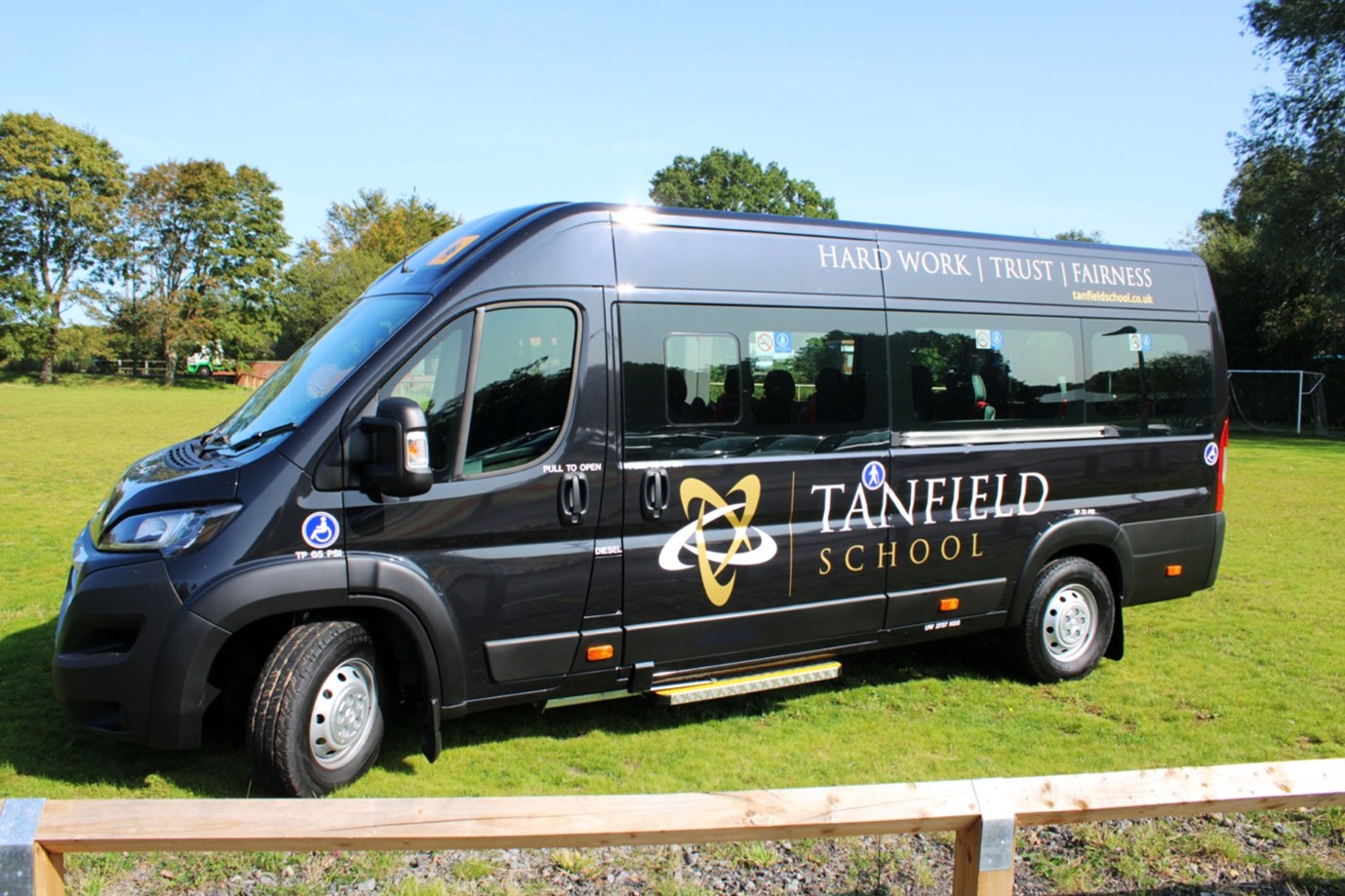
Picture of black minibus on a school field. The mini bus is covered in Tanfield School logos and branding.

For the purposes of this document the term “minibus” will apply to all vehicles. “Minibus” is defined as a motor vehicle which is constructed or adapted to carry more than 8 but not more than 16 seated passengers in addition to the driver. (Construction and Use Regulations 1986).

2. Manager’s responsibilities

The school minibus is managed by the Chief Operating Officer in conjunction with the Business Services Team.

The Chief Operating Officer has responsibility for the safe operation and daily use of the minibus, including security. The Chief Operating Officer is responsible for maintaining driver records and logs as well as ensuring driver competence.

The Chief Operating Officer has responsibility for procurement, insurance and associated contracts.

3. Important classifications

There are two main categories of drivers for the school minibus:

3.1 Pre-1997

Drivers who were issues with a full driving licence category A/B/D1 are entitled to drive the school minibus in the UK. They may also drive in Europe as long as it is not under Section 19 or for hire or reward. If this is the case, they must have passed a Passenger Carrying Vehicle (PCV) test. As a school requirement all drivers of this category must also complete training and hold a valid MIDAS certificate.

3.2 Post-1997

Drivers who passed their test post 1st January 1997 who are required to drive the minibus will also be able to do so on their licence. This is because the minibus is a ‘lite’ vehicle that has a Maximum Authorised Mass (MAM) less than 3.5 tonnes. As a school requirement all drivers of this category must also complete training and hold a valid MIDAS certificate.

In addition to the correct driver licensing, all drivers:

*           Will be over 21 years old

*           Hold a category B licence for at least two years

4. Section 19 permits

Tanfield School has a Section 19 dispensation. This exempts the school from some of the statutory requirements for driving minibuses. A disk detailing this is displayed in the windscreen of the vehicle indicating the driver is operating on a Section 19 Permit.

A driver operating under a Section 19 Permit is driving in a voluntary role rather than as part of their employment contract.

A Section 19 Permit means that payment by passengers is not allowed in any way. Only a totally free transport service, paid for by Tanfield School in full, meets the exemption requirements of a Section 19 Permit.

The permit expires on 26th October 2025 and must be renewed before then.

5. Minibus speed limits

The school minibus is governed by lower national speed limits than a car. Where a speed limit is signed in numbers (e.g. 30) this limit applies. Where a national speed limit is signed the following applies:

*           Single carriageway – 50 mph

*           Dual carriageway – 60 mph

*           Motorway – 70 mph

The school minibus is fitted with a speed limiter set at 62 mph. This is displayed in the driver’s cab and on the rear door for other road users to see. Speed limited minibuses are not permitted in the outside lane of a three or more lane motorway.

6. Requirements for drivers of the minibus

It is Tanfield School policy to require all minibus drivers, irrespective of their driving licence status, to complete a Minibus Driving Awareness Scheme (MIDAS) training course if driving a minibus.

*           All drivers are required to be between the ages of 21-65. The age may be extended to 65-70 subject to passing a MIDAS test and in consultation with the relevant guidance bodies.

*           All drivers must hold a full UK driving licence with category B, D or D1.

*           The driving licence must have been held for a minimum of two years.

*           All drivers must hold a valid MIDAS certificate which must be renewed at least every four years.

*           Drivers with penalty points on their licence must seek recorded approval from the Chief Operating Officer before undertaking any journeys. Tanfield School insists on no more than three penalty points to become and remain an approved driver.

*           All drivers must inform the Chief Operating Officer of any changes or endorsements to their licence immediately.

*           The Chief Operating Officer will ensure a robust system of near miss and incident reporting as part of the monitoring of drivers.

7. Risk assessment

The Health and Safety Team are required to conduct a thorough risk assessment regarding the use of the minibus, and should consider:

  • Drivers must be suitably rested before undertaking long journeys, particularly when the event is planned after a member of staff has completed a standard working day.

Additional MIDAS information:

  • Any journey expected to be over four hours long will require two drivers.

  • Drivers should plan journey times to accommodate:

  • 15-minute break or change of drivers every two hours, and

  • A 30-minute break after four hours.

  • Where appropriate, formal consent will be obtained from parents and carers. Note: This is not required for visits during school time – refer to DfE guidelines, Health and Safety of Pupils on Educations Visits, page 21 section 112.

  • When transporting young people or vulnerable adults on trips the risk assessment process must consider if an additional adult is required for supervision during the journey.

  • All staff must be familiar with the emergency arrangements, including firefighting equipment, safe disembarkation in the event of emergency, first aid provision and any special medical needs.

  • All staff must be advised of pick up and drop off arrangements and ensure safe systems are in place in the event of drop offs requested by passengers outside of agreed plans.

  • All staff must know how to conduct a safe emergency stop which includes stopping in a place of safety and, on motorways, disembarking away from the vehicle. Staff must be familiar with the vehicle details for contacting recovery services etc.

  • Ensure drivers have access to a mobile phone (not to be used by the driver whilst the vehicle is in motion), to use in an emergency, with relevant contact numbers.

  • All staff must be aware that the minibus is not to be used for carrying hazardous substances such as oxygen, cleaning chemicals, or large equipment.

8. Driver’s hours

When a driver is driving under a Section 19 Permit the driver’s hours rules do not apply. No tachograph is fitted to the minibus.

Drivers of any vehicles are considered as the responsible person in law for the safety of their passengers and it is the driver’s responsibility to ensure that the vehicle being used is in a safe condition to drive. A daily check list is provided.

Drivers are responsible for their own fitness to drive and should report any health issues or adverse events which may compromise their fitness to do so. Any prosecution resulting from the negligent driving or operation of a vehicle will, in most cases, result in penalty points being put onto the named driver’s licence, and in some cases may result in a custodial sentence.

9. Driver’s responsibilities

Fuel for the vehicles may be purchased at any garage that is part of the fuel card scheme and payment is made through the appropriate fuel card scheme. A card is held by the school and will be issued, should it be required, on the day of the journey.

Please note the vehicle runs on diesel.

Drivers are required to:

  • Check the safety of the vehicle before each and every journey, using the form provided.

  • Report promptly any defects or concerns to the Chief Operating Officer.

  • Not drive a vehicle which they know to be defective.

  • Be fully familiar with the content of the risk assessment for the journey.

  • Be familiar with routes and all arrangements detailed in the risk assessment.

  • Ensure all loads are secured appropriately before departure.

  • Ensure all access, egress and gangway routes are kept clear.

  • Ensure seatbelts are worn correctly before commencing journey.

  • Be familiar with the breakdown procedures in the event of breakdown, accident or significant delay, including the details of recovery companies.

  • Be familiar with the agreed code of conduct for passengers and avoidance of distracting the driver.

  • Where relevant, bring to the attention of a trip leader any concern regarding passenger’s conduct.

  • Where supervisors are being used, ensure they are spread throughout the vehicle and briefed appropriately on arrangements in the event of an emergency.

  • Make an official announcement with reference to wearing seat belts.

  • Ensure robust arrangements for dropping off at the end of a journey, particularly where the drop is not the final destination. It is the driver’s duty to make every reasonable effort to ensure any drop off arrangements have been agreed with parents and carers, and that the young person is left in a place of safety.

10. Record keeping and administration

A copy of the insurance certificate is kept in the minibus. The insurance will cover:

  • All activities for which the minibus is to be used.

  • The total number of passengers allowed and the total weight (including passengers and luggage).

The following records must be kept:

  • All documents relating to the vehicle and original manufacturer’s information.

  • An operating log including booking the vehicle in and out, held on a trip basis in the minibus and returned to the office of the Chief Operating Officer.

  • Accident/incident records, including faults reported and rectified.

  • A list of authorized drivers.

  • Training and retraining records.

  • Medical check details, kept strictly confidential.

  • Emergency equipment logs.

  • Details of any vetting conducted.

  • Maintenance and safety check documents.

  • First aid checklist.

As the minibus will be operating under Section 19 Permit rules, it will have a ten-week service/safety inspection completed by a competent person. This record will form part of the logs.

The pre-journey walk around check must be completed by the driver and a hard copy kept on file.

11. Booking

All booking is carried out through the resource calendar available on Google Calendar. Risk assessments must be completed and handed to the Health and Safety Team as part of the documentation for the trip five days before use. When the risk assessment and booking have been confirmed the keys will be issued and the daily check log completed on the day of the journey.

12. Cleaning responsibilities

As a shared resource, it is important that the minibus is maintained in such a way that all users have a positive experience. It is the responsibility of the driver to ensure that on the return of the minibus it is clean and tidy. Bin bags will be provided in the minibus and a dustpan and brush is also provided should it be required.

Appendix 1 – Documents and equipment maintained in the minibus

  • Details of procedures for accidents and breakdowns

  • Pre-Journey Safety Check forms

  • Advice for minibus drivers

  • Advice for passenger assistants

  • Advice for children/young people

  • First aid kit

  • Fire extinguisher

  • High visibility vests

  • Emergency warning triangle to be used in compliance with the Highway Code 274

  • Emergency procedure instructions

  • Telephone contact numbers

  • A copy of the insurance certificate

  • A copy of the Section 19 Permit

  • Accident and near miss forms

  • A torch and spare batteries

  • A pen and pad

  • Dustpan and brush

  • Bin bags

  • Sick bags

  • Wipes, tissues and hand sanitizer

Appendix 2 – Incident reporting

Description of incident. Please ensure any incident is reported as soon as possible to the school office (upon return at the latest).

FOR OFFICE USE ONLY:

Action taken to remedy the incident.

Details of any third parties involved:

Name

Address

Contact no

Vehicle registration details

Insurance details

Please take photographs of incident

Staff should be aware that an insurance policy may be invalidated by the following:

*            A driver admitting liability after an accident, or

*            Failure to report the accident to the insurer, or

*            Failure to undertake adequate safety checks of the vehicle, or

*            Failure to wear the seatbelts

Sign:


Sign:

Date:


Date:

Appendix 3 – Minibus vehicle checklist

Current mileage

Items to check

Yes

No

Comments

Tyre pressure -record PSI

Tyre condition

Indicators

All other lights (inc interior)

Fuel level (min half tank)

Oil level

Adblue level

Water level

Windscreen wipers & washers

Horn

Mirrors

First aid kit

Fire extinguisher

Warning triangle

Hi-vis vests

Small bus permit displayed

Current MOT

Spare wheel & equipment

Emergency doors

Reversing vehicle alarm

Fuel cut off switch

Carrying capacity sign

Exterior vehicle condition

Interior vehicle condition

Other issues

Inspected by

Date

Signed

Appendix 4 – Vehicle journey log sheet

Date:

Mileage out:

Mileage in:

Signed:

Time out:

Time in:

Name of driver:

Name of additional supervisors:

Destination:

Purpose of journey:

Checklist

Fuel – record level                                                          E – ¼ - ½ - ¾ - F

Lights & indicators

Windscreen wipers/washers

Visual inspection of tyres

Visual check for water/oil leaks

Visual inspection of bodywork/bumpers/lights

Any defects to be noted and reported immediately upon return to school office

Diagram, engineering drawingDescription automatically generated

Details:

Passenger log (name)

1.

5.

9.

13.

2.

6.

10.

14.

3.

7.

11.

15.

4.

8.

12.

16.

Appendix 5 – Emergency breakdown and evacuation procedures

Because of the multitude of potential scenarios there cannot be a definitive guide to emergency breakdown and evacuation procedures. This information is provided as a guide. Further support will be available from school should it be needed.

5.1 Preparation

  • Additional supervising staff should sit centrally so as to oversee both doors and attend to passengers quickly if needed.

  • All staff on the vehicle should be familiar with the position and operation of the main and emergency doors, location of the first aid box, torch, warning triangle and hi-vis vests.

  • All staff on the vehicle should be familiar with the location and operation of the fire extinguisher as well as the emergency engine cut off switch.

  • Exits must be kept unlocked and clear while moving.

  • A mobile phone must be carried by at least one member of staff.

  • Identify students who would be particularly at risk in an emergency situation because of individual medical needs.

  • No inflammable liquids are to be carried on the vehicle.

  • Passengers should be made aware of what they should do in an emergency.

5.2 In the event of an incident

  • Where possible, the driver has the responsibility for the evacuation of the vehicle.

  • Remember that a very ill passenger or driver would be considered an emergency, enabling you to stop on the hard shoulder of a motorway if necessary.

  • Do not attempt to extinguish fires until the vehicle is clear of all occupants.

  • Evacuate to a safe place, using the main door if possible. If needed, use the emergency exit. If a window needs to be broken to exit use the fire extinguisher at arm’s length with eyes shielded. Control the evacuation, ensuring passengers do no stray in to oncoming traffic.

  • Move the passengers to a place of safety aware from the road and call the emergency services.

  • Once everyone is accounted for and the emergency services are informed, the NEXT CALL should be made to the school. This will allow for remote assistance and execution of the school’s Business Continuity Plan.