At Tanfield School we are committed to supporting the mental health and wellbeing of pupils, parents, carers, staff and other stakeholders.
Mental Health & Wellbeing Policy
Mental Health & Wellbeing
Table of Contents
1. Policy statement
2. Scope
This policy is intended to:
- Provide guidance to school staff on our school’s approach to promoting positive mental health and wellbeing across all communities in the school
- Inform pupils and parents about the support that they can expect from the school in respect of supporting mental health and wellbeing
Read this policy in conjunction with:
- SEND policy
- Behaviour policy
- Anti-bullying policy
- Safeguarding policy
3. Policy aims
- Promote positive mental health and wellbeing across the whole school
- Create a culture of wellbeing and inclusion
- Foster a positive atmosphere in school, where pupils feel able to discuss and reflect on their own experiences with mental health openly
- Celebrate all of the ways pupils achieve at our school, both inside and outside the classroom
- Allow pupils to participate in forming our approach to mental health by promoting pupil voice
- Give pupils the opportunity to develop their self-esteem by taking responsibility for themselves and others
- Spread awareness of the varieties of ways mental health issues can manifest
- Support staff to identify and respond to early warning signs of mental health issues
- Provide support to staff working with pupils with mental health issues
- Provide support and access to resources to pupils experiencing mental ill health alongside their peers, their families and the staff who work with them
4. Legal basis
This policy was written with regard to:
- The Equality Act 2010
- The Data Protection Act 2018
- Articles 3 and 23 of the UN Convention on the Rights of the Child
5. Roles and responsibilities
All staff are responsible for promoting positive mental health and wellbeing across the school and for understanding risk factors. If any members of staff are concerned about a pupil’s mental health or wellbeing, they should inform Mr C Jones our designated safeguarding lead (DSL) and Mrs S Douglas or mental health lead.
6. Procedure to follow in a case of acute mental health crisis
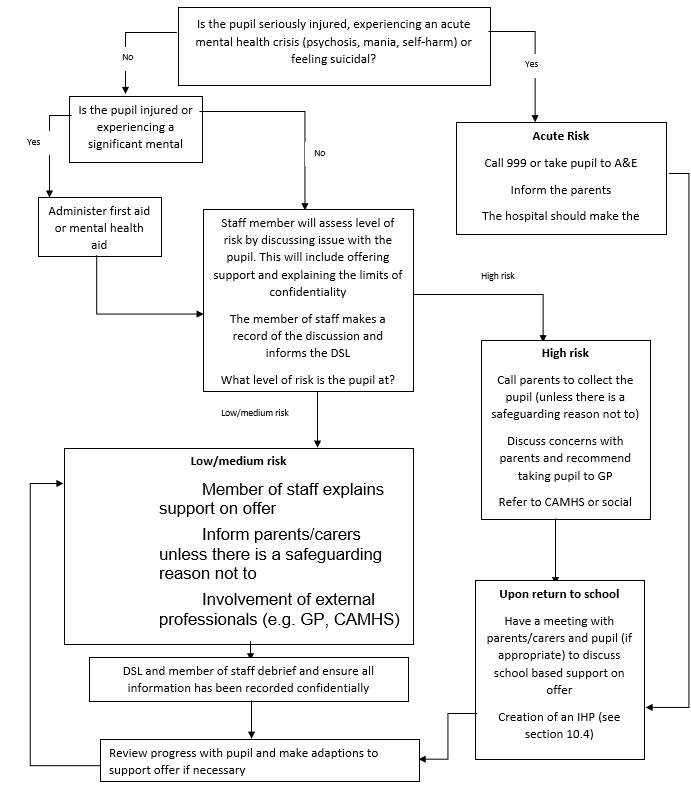
7. Warning signs
All staff will be on the lookout for signs that a pupil's mental health is deteriorating. Some warning signs include:
- Changes in mood or energy level
- Changes in eating or sleeping patterns
- Changes in attitude in lessons or academic attainment
- Changes in level of personal hygiene
- Social isolation
- Poor attendance or punctuality
- Expressing feelings of hopelessness, anxiety, worthlessness or feeling like a failure
- Abuse of drugs or alcohol
- Weight loss or gain
- Secretive behaviour
- Covering parts of the body that they wouldn’t have previously
- Refusing to participate in P.E. or being secretive when changing clothes
- Physical pain or nausea with no obvious cause
- Physical injuries that appear to be self-inflicted
- Talking or joking about self-harm or suicide
8. Managing disclosures
If a pupil makes a disclosure about themselves or a peer to a member of staff, staff should remain calm, non-judgmental and reassuring.
Staff will focus on the pupil’s emotional and physical safety, rather than trying to find out why they are feeling that way or offering advice.
Staff will always follow the school’s safeguarding policy and pass on all concerns to the designated safeguarding lead or mental health lead. All disclosures should be recorded on CPOMS.
9. Confidentiality
Staff should not promise a pupil that they will keep a disclosure secret, instead they will be upfront about the limits of confidentiality.
A disclosure cannot be kept secret because:
- Being the sole person responsible for a pupil’s mental health could have a negative impact on the member of staff’s own mental health and wellbeing
- The support put in place for the pupil will be dependent on the member of staff being at school
- Other staff members can share ideas on how to best support the pupil in question
Staff should always share disclosures with at least one appropriate colleague. This will usually be the DSL / mental health lead. If information needs to be shared with other members of staff or external professionals, it will be done on a need-to-know basis.
Before sharing information disclosed by a pupil with a third party, the member of staff will discuss it with the pupil and explain:
- Who they will share the information with
- What information they will share
- Why they need to share that information
Staff will attempt to receive consent from the pupil to share their information, but the safety of the pupil comes first.
Parents will be informed unless there is a child protection concern. In this case the child protection / safeguarding policy will be followed.
9.1 Process for managing confidentiality around disclosures
Pupil makes a disclosure
Member of staff offers support
Member of staff explains the issues around confidentiality and rationale for sharing a disclosure with DSL / mental health lead
Member of staff will attempt to get the pupil’s consent to share – if no consent is given, explain to the pupil who you will share the information with and explain why you need to do this
Member of staff will record the disclosure on CPOMs and share the information with the chosen elected member of staff
The DSL / mental health lead will inform the parent/carer (if appropriate)
Any other relevant members of staff or external professionals will be informed on a need-to-know basis
10. Supporting pupils
10.1 Baseline support for all pupils
As part of the school’s commitment to promoting positive mental health and wellbeing for all pupils, the school offers support to all pupils by:
Raising awareness of mental health during advisory time, PSHE and mental health awareness week
Signposting all pupils to sources of online support e.g. Kooth
- Having open discussions about mental health during lessons
- Providing pupils with avenues to provide feedback on any elements of the school that is negatively impacting their mental health
- Monitoring of all pupils’ mental health through assessments e.g. a strengths and difficulties questionnaire
- Appointing a senior mental health lead with a strategic oversight of our whole school approach to mental health and wellbeing – Mrs S Douglas
- Offering pastoral support through Year Managers role
- Making classrooms a safe space to discuss mental health and wellbeing through interventions such as:
Peer mentoring
Staff mentoring
Resilience nurse
Family Health Nurses
School counsellor
10.2 Assessing what further support is needed
If a pupil is identified as having a mental health need the SEND team will take a graduated and case-by-case approach to making an assessment and providing tailored support, further to the provision of the baseline support as detailed in section 10.1. The school will offer support in cycles of:
- Assessing what the pupil’s mental health needs are
- Creating a plan to provide support
- Taking the actions set out in the plan
- Reviewing the effectiveness of the support offered
10.3 Internal mental health interventions
Where appropriate, a pupil will be offered support that is tailored to their needs as part of the graduated approach detailed above. The support offered at our school includes:
- Nurture groups
- Reduced timetable
- Red, amber and green cards
- Mentoring
- Peer mentoring
- Resilience nurse
- Family Health Nurse
- ASC social thinking groups
- Counselling
- SEMH base
- Link access
10.4 Individual healthcare plans (IHPs)
A pupil will be offered an individual healthcare plan (IHCP) if required.
IHCPs are written in collaboration with the pupil (if appropriate), their parent/carer, and any other relevant professionals.
The pupil’s IHP will contain the following details:
- The mental health issue (and its triggers, signs, symptoms and treatments)
- The pupil's needs resulting from the condition
- Specific support for the pupil’s educational, social and emotional needs
- The level of support needed
- Who will provide the support
- Who in the school needs to be aware of the child’s condition
- What to do in an emergency
10.5 Making external referrals
If a pupil’s needs cannot be met by the internal offer the school provides, the school will make, or encourage parents to make, a referral for external support.
A pupil could be referred to:
- GP or paediatrician
- CAMHS
- Mental health charities (e.g. Samaritans, Mind, Young Minds, Kooth)
- Local counselling services
- EWEL (Emotional Well-being and Effective Learning Team)
11. Supporting and collaborating with parents and carers
We will work with parents and carers to support pupils’ mental health by:
- Asking parents/carers to inform us of any mental health needs their child is experiencing, so we can offer the right support
- Informing parents/carers of mental health concerns that we have about their child
- Engaging with parents/carers to understand their mental health and wellbeing issues, as well as that of their child, and support them accordingly to make sure there is holistic support for them and their child
- Highlighting sources of information and support about mental health and wellbeing on our school website, including the mental health and wellbeing policy
- Liaising with parents/carers to discuss strategies that can help promote positive mental health in their child
- Providing guidance to parents/carers on navigating and accessing relevant local mental health services or other sources of support (e.g. parent forums)
- Keeping parents/carers informed about the mental health topics their child is learning about in PSHE, and share ideas for extending and exploring this learning at home
When informing parents about any mental health concerns we have about their child, we will endeavour to do this face to face.