Low-level Concerns Policy

Low-level Concerns

Table of Contents

1. Introduction

At Tanfield School, we aim to create an open and transparent culture where all concerns about all adults involved with our school are dealt with promptly and appropriately. We aim to identify any concerning, problematic or inappropriate behaviour early; minimise the risk of abuse; and ensure that adults working in or on behalf of our school are clear about professional boundaries and act within these boundaries, and in accordance with our school ethos.

This policy should be read alongside our Safeguarding and Child Protection and Staff Code of Conduct Policies.

2. Summary

It may be possible that a member of staff acts in a way that does not cause risk to children, but is however inappropriate. A member of staff who has a concern about another member, adult, volunteer, contractor or who, on reflection, recognises that their actions could have been viewed as a risk should inform the Head Teacher about their concern using a Low-Level Record of Concern Form. If the Head Teacher cannot be contacted, the Deputy Head Teacher should be contacted instead.

3. Keeping Children Safe in Education September 2024

The following is taken from Keeping Children Safe in Education 2024 and identifies what may be considered behaviour relating to low level concern:

What is a low level concern (LLC)?

409. The term ‘low-level’ concern does not mean that it is insignificant, it means that the behaviour towards a child does not meet the threshold set out at paragraph 338 (and on page four of this policy in the red box). A low-level concern is any concern – no matter how small, and even if no more than causing a sense of unease or a ‘nagging doubt’ - that an adult working in or on behalf of the school or college may have acted in a way that:

  • is inconsistent with the staff code of conduct, including inappropriate conduct outside of work; and

  • does not meet the allegations threshold or is otherwise not considered serious enough to consider a referral to the LADO.

410. Examples of such behaviour could include, but are not limited to:

  • being over friendly with children;

  • having favourites;

  • taking photographs of children on their mobile phone;

  • engaging with a child on a one-to-one basis in a secluded area or behind a closed door; or,

  • using inappropriate sexualised, intimidating or offensive language.

411. Such behaviour can exist on a wide spectrum, from the inadvertent or thoughtless, or behaviour that may look to be inappropriate, but might not be in specific circumstances, through to that which is ultimately intended to enable abuse.

412. It is crucial that any such concerns, including those which do not meet the harm threshold (see Part Four - Section one), are shared responsibly and with the right person, and recorded and dealt with appropriately. Ensuring they are dealt with effectively should also protect those working in or on behalf of schools and colleges from potential false allegations or misunderstandings

4. Clarity around Allegation vs Low-Level

Allegation:

Any adult linked to our school who has:

behaved in a way that has harmed a child, or may have harmed a child and/or;

possibly committed a criminal offence against or related to a child and/or;

behaved towards a child or children in a way that indicates he or she may pose a risk of harm to children; and/or

behaved or may have behaved in a way that indicates they may not be suitable to work with children.

Low Level Concern:

Any adult linked to our school who has behaved in a way that:

is inconsistent with the staff code of conduct, including inappropriate conduct outside of work; and

does not meet the allegations threshold or is otherwise not considered serious enough to consider a referral to the LADO.

Appropriate:

Behaviour which is entirely consistent with our school’s Code of Conduct, and the Law.

5. Storing and use of low-level concerns and follow-up information

LLC forms and follow-up information will be stored securely within the schools safeguarding systems, with access only by the leadership team. This will be stored in accordance with the school’s GDPR and data protection policies.

The staff member(s) reporting the concern must keep the information confidential and not share the concern with others apart from the Head Teacher or those aware in the senior leadership team.

Low-Level Concerns will not be referred to in references unless they have been formalised into more significant concerns resulting in disciplinary or misconduct procedures.

Whenever staff leave Tanfield School any record of low-level concerns which are stored about them will be reviewed as to whether or not that information needs to be kept.

Consideration will be given to:

(a) whether some or all of the information contained within any record may have any reasonably likely value in terms of any potential historic employment or abuse claim so as to justify keeping it, in line with normal safeguarding records practice; or

(b) if, on balance, any record is not considered to have any reasonably likely value, still less actionable concern, and ought to be deleted accordingly

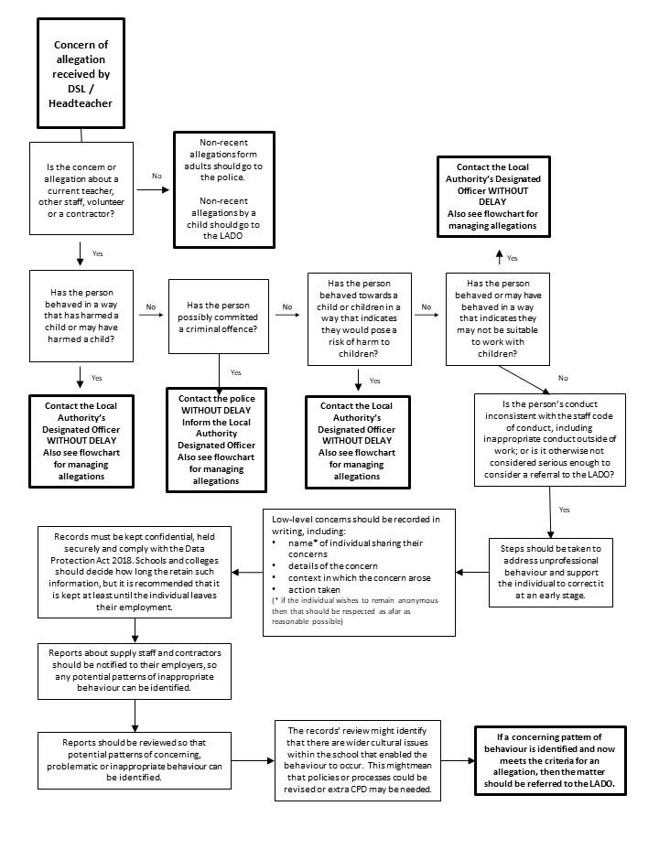
6. Process to follow when a low-level concern is raised

A detailed decision-tree flowchart outlining the procedure for responding to safeguarding concerns or allegations against staff, volunteers, or contractors, moving from initial assessment to LADO referrals, managing low-level concerns, and record-keeping.

Low Level Concerns Reporting Form

                                             Your details

Name (optional)


Role


Date and time of completing this form

Details of individual (including yourself for self-reporting) whom the concern is about

Name

Role

Relationship to the individual reporting eg manager, colleague

Details of concern

Please include as much detail as possible. Think about the following: What behaviour and/or incident are you reporting? What exactly happened? Why does the behaviour and/or incident worry you? Why do you believe the behaviour and/or incident is not consistent with our Staff Code of Conduct?

Details of any children or young people involved

Name(s)


Next Steps

Are you willing to meet with the

headteacher and DSL to discuss your concern? Please circle as appropriate.


Yes


No

Please state any other information that you feel is relevant to the processing

of this concern.

Signature

For use by HT/safeguarding team upon receipt of the concern

Date and time concern received

Signature


Role


Actions to be taken and follow-up.


Appendix A - Fact Finding Advice

Before contacting the LADO, schools and colleges should conduct basic enquiries in line with local procedures to establish the facts and to help them determine whether there is any foundation to the allegation, being careful not to jeopardise any future police investigation.  Please liaise with HR as necessary.

Basic enquiries could include the following:

  • was the individual in the school or college at the time of the allegations

  • did the individual, or could the individual have come into contact with the child

  • Are there any witnesses, any CCTV footage?

When fact finding you may find it helpful to use the 5 WH model of open questions:

  • Who

  • What

  • Where

  • When

  • Why (context/ events leading up to incident)

Examples include:

“What did you see/hear/experience?” “When did the situation occur?” “Where did the situation occur?” “Who was involved?” “How were you impacted by what occurred?” or “How do you see the situation?” “Was anyone else present?” “What was their involvement?” “Can you tell me more?”

If your initial fact finding indicates the allegation could not have happened (e.g. child/ individual to whom the allegation relates was not in school, or physically the incident could not have happened (e.g. slamming a soft closed door) this does not need to be reported to LADO.  You will need to keep a record of your allegations management decision making within school/ college.  Please ensure any statements from students are signed and dated by the student.

You should advise parent/ child of the outcome of your fact finding (e.g. referral to LADO, dealing with incident as a low level concern or that the allegation could not have happened and explain why)

Threshold for LADO: (Please ensure you are familiar with Durham Safeguarding Children Partnership procedures for managing allegations against staff and volunteers who work with children.) 

  • behaved in a way that has harmed a child, or may have harmed a child

  • possibly committed a criminal offence against or related to a child

  • behaved towards a child or children in a way that indicates he or she may pose a risk of harm to children

  • behaved or may have behaved in a way that indicates they may not be suitable to work with children.

If you consider that any of the above points are met, a referral needs to be made to LADO within 1 working day – 03000 268835

A referral to LADO does not negate your safeguarding responsibilities.  If a child is at risk of imminent harm and/ or you suspect a criminal offence may have occurred, you MUST follow safeguarding procedures and liaise with Children’s Services (First Contact) and/or Police before making a referral to LADO. 

Low level concerns (Keeping Children Safe In Education)

Governing bodies and proprietors should have policies and processes to deal with any concerns or allegations which do not meet the harm threshold.  This is referred to in KCSIE as ‘low-level’ concerns. It is important that schools and colleges have appropriate policies and processes in place to manage and record any such concerns and take appropriate action to safeguard children

The term ‘low-level’ concern does not mean that it is insignificant. A low-level concern is any concern (no matter how small, and even if no more than causing a sense of unease or a nagging doubt) that an adult working in or on behalf of the school or college may have acted in a way that is inconsistent with the staff code of conduct, including inappropriate conduct outside of work and does not meet the harm threshold or is otherwise not serious enough to consider a referral to the LADO.

Examples of such behaviour could include, but are not limited to:

  • being over friendly with children

  • having favourites

  • engaging with a child on a one-to-one basis in a secluded area or behind a closed door when it is not part of their role

  • humiliating children.

Such behaviour can exist on a wide spectrum, from the inadvertent or thoughtless, or behaviour that may look to be inappropriate, but might not be in specific circumstances, through to that which is ultimately intended to enable abuse.

Low-level concerns may arise in several ways and from a number of sources. For example: suspicion; complaint; or disclosure made by a child, parent or other adult within or outside of the organisation; or as a result of vetting checks undertaken.

It is crucial that all low-level concerns are shared responsibly with the right person and recorded and dealt with appropriately. Ensuring they are dealt with effectively should also protect those working in or on behalf of schools and colleges from becoming the subject of potential false low-level concerns or misunderstandings.

If threshold for LADO is not met:
  • Follow your low-level concerns policy

  • Log your decision making internally – this does not need to be reported/ logged with LADO