Every day, students are required to revisit prior learning in order to interrupt the forgetting of knowledge. The forgetting curve shows how learned information slips out of our memories over time – unless we take action to keep it there. The steepest drop in memory happens quickly after learning, so it's important to revisit the information you've learned sooner rather than later.
Homework Policy
Homework
Table of Contents
1. Rationale: Why we do what we do
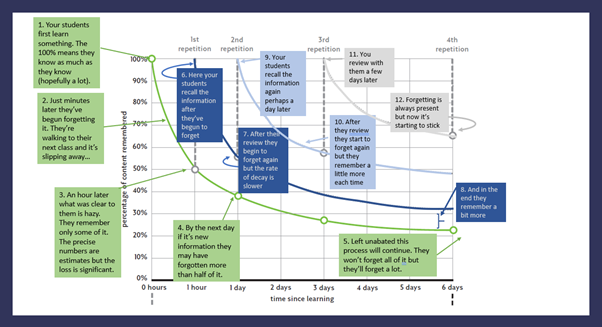
At Tanfield, a culture of revision is at the heart of students’ everyday practice in Morning Meetings, in lessons and it is central to all home learning. The students’ Reflection and Retrieval books are a key part of this process. Homework is designed to ensure the development of powerful knowledge and practise the application of that knowledge. Homework enhances pupil learning, improves achievement and develops students' independent study skills and as such is an integral part of the curriculum. Students are given all the learning resources that they need to complete homework and extended support is available at school for students to maximise their learning.
Homework enables students to:
Develop powerful knowledge
Practise the application of knowledge and skills
Address knowledge and skills gaps
Consolidate and extend work covered in class
Prepare for examinations
Develop powerful learning habits including Hard Work and Resilience
2. Homework at Tanfield
At Tanfield School we will:
Set homework to the homework timetable
Assign homework task: quizzing and one of the 3 core revision strategies.
Set tasks that Stretch and Challenge
Create homework that prepares students for learning that will take place in school
Relate homework to the focus on retrieval practice to prepare for learning that has taken place in school
Assess homework and give feedback
Provide support for students, eg: homework guidance, Junior Champions, support in the Link. directed homework support sessions, Champions Hour and signed up transport at 4pm and 5pm.
All homework is assigned in the Google classrooms in line with the homework timetable for Years 7-10. Students in Years 7-10 also have the knowledge quizzing banks to use to support assessment preparation which may be incorporated into homeworks and will be in morning meeting quizzing and recaps in lessons.
2.1 Year 7, 8 and 9 Homework
Years 7, 8 and 9 Homework Expectations : maximum 60 minutes as maximum Monday-Friday | ||
Task | Where is it completed | Checked by |
| Year group Google Homework classroom* *may include link to online quizzing | Year lead (SL assigned role) |
| Homework Book | Advisors only check LCWC on Wednesday and Friday mornings. |
2.2 Year 10 Homework
Years 10 Homework Expectations: minimum 60 minutes Monday-Friday | ||
Task | Where is it completed | Checked by… |
G.C.S.E Subjects
| Google subject classroom* *may include link to online quizzing | Class teacher online |
| Homework Book | Advisors only check for LCWC, mindmaps, Cornell notes of flashcards on Wednesday and Friday mornings. |
| Task on Google subject classroom/paper | Class teacher |
BTEC subjects Homework will be set in line with the current course focus:
| On Google classroom Using KOs or revision materials | Class teacher |
2.3 Year 11 Homework
*Y11 does not have a set timetable, subjects are guided to set homework deadlines through the subject Google classroom and ensure adequate time is given to complete tasks. Homework quizzing is a weekly expectation for all subjects as a minimum.
Year 11 minimum 60-90 minutes * this will be adapted for the final Cycle before the final G.C.S.E. examinations | |
Tasks | Where is it completed |
| Resources and guidance on the Google subject classroom* Revision Guides and KOs *may include link to online quizzing |
3. We are what we do
At Tanfield, as we work towards our sentence, we seek to create a culture where we do the right thing as it is the right thing to do. We work hard, give 100% and do not give up. We recognise and appreciate all of Team Tanfield who live our values of Hard Work, Trust and Fairness. At the same time, we recognise and expect those who have not lived by those values, to reflect, to reset and to correct.
3.1 Appreciating engagement and achievement
Positives will be awarded for:
Revision using Knowledge quizzing banks
100% Quiz scores
Revision Strategy tasks completed to the standard expected
Quality optional Stretch homework
Assignments completed to deadlines and to expectations
Class teachers should narrate the positive with regard to homework and share examples of homework that demonstrate our values of Hard Work, Trust and Fairness. We will also issue praise postcards and make phone calls home to appreciate homework engagement and achievement
3.2 Driving Homework engagement
When homework is not completed, teachers should initially remind students of the 100%/ expectation, the fractional daily goals expectations and narrate why we have homework and why we do what we do. Teachers will remind students of expectations, narrating the positives, and set the final deadline for expectations to be met. As a team we will always provide support aiming to remove barriers that prevent completion of tasks. For the revision strategy section students will stay back after the afternoon meeting to complete this missed aspect of the homework for 60 minutes. A text message will inform parents. Y11 may be guided to Champions Hour to support focused Progress Check revision or other work as required and following discussions with parents.
If homework quizzing is still not completed, then sanctions should be used by class teachers. Teachers receive support from their Subject Leader, Heads of Student Guidance and Senior Leadership Staff. The sanctions are as follows:
Class teacher – discussion with student, after school detention,[1] and informing parents via the awarding a negative on Arbor and a text via the main office. Any phone calls home must be logged on Arbor.
Subject Leaders – speak to students who have persistently not completed homework. Subject Leader detention for non-completion of homeowyear lead teacher detention[2] . Refer to Head of Student Guidance and Year Manager for students persistently failing to complete homework and for non-attendance.
Advisors - through monitoring of Look, Cover, Write and Check/given revision strategy, identify students with homework problems across several curriculum areas and refer to Head of Student Guidance as well as Year Managers.
Year Manager– parental contact including meetings, refer to Behaviour Support staff, Head of Student Guidance or Assistant Head (as appropriate) in the case of students persistently failing to complete homework
Persistent incompletion of homework will lead to students being directed to homework detention sessions, from 3:10pm-4pm, for three consecutive weeks. This is to support students resetting their homework routine and ensure that they keep up-to-date with homework. Persistent criteria- missing the same subject 3 consecutive times, missing more than 3 subjects in a week.
In cases where personal circumstances prevent students from completing homework, the Year Manager must inform the Subject Leader and class teacher so they can provide support. This may involve differentiated work, opportunities to complete the work in school, or in a different format. The expectation of students completing homework remains. Homework club is available in N133 the Link based to support all students with the completion of homework and is staffed to support this.
Junior Champions is available for all students 3:10-4pm for homework support which is staffed.
KS3 and KS4 English, Maths and Science homework expectations and detentions
Tassomai English and Science (* This also applies to KS4 History and Geography)
Students must complete a minimum of three separate Tassomai fractional daily goals per week.
Each week runs from Monday to Sunday.
A detention will be issued for incomplete homework if there are fewer than three fractional daily goals completed in Years 7-10 and for fewer than 5 fractional daily goals in Year 11.
Students must ensure they complete the Fractional Daily Goal target weekly - Tassomai will inform them when they have done this.
The option is there to complete more than the target - this extra effort will be rewarded.
These tasks must be completed by the end of Sunday.
Homework will be checked on a Monday morning.
If students fail to complete their fractional daily goals target on Tassomai they will be issued with a detention the following week in line with Behaviour Policy.
Maths
Students are required to complete the 1 hour Maths per week, split over 3 nights and ensure 100% completion. For Year 11 there is a nightly task during the week.
In summary, each subject has a separate detention night depending on the criteria outlined above.
Absence
If a student is absent for 4 or more days, homework incompletion will not be sanctioned for the days when a student was not in school.
For any other length of absence, students are required to complete all homework. Incompletion of homework will be sanctioned inline with Behaviour policy.
NB: Sanctions and Incentives may change following the current review of Whole School Rewards
4. Responsibilities at Team Tanfield
4.1 The role of the students
To watch the presentation, complete the quizzing section of homework aiming for 100% and submit the quiz assignment. For English and Science, complete the Tassomai quiz and for Maths the Sparx quizzing.
To complete the revision strategy task in homework books and have this ready to show advisors each Wednesday and Friday morning.
May complete the optional stretch
Attempt all work and give their best
To inform the class teacher of any difficulties
4.2 The role of the Advisors Years 7-10
To monitor setting out homework by students in the morning meeting and check homework books in the morning meeting for quality of work and completion to expectations. Titles and dates are underlined and all work is neatly presented with effort and pride.
To check the completion and quality of the revision Strategy task section of homework Wednesday and Friday mornings for Year 7-10.
Advisor to check, and sign off, the completion and quality of the homework that there is one full page of Look, Cover, Write and Check in their Reflection and Retrieval book. For the Look, Cover, Write and Check there is black and green pen evident. See the model included in the morning meeting WTD.
Reward positives for completion of the Revision Strategy Task which are to the high standard expected.
To note and respond to any homework not completed, informing the Year Manager and Head of Student Guidance for students to be in detention after school that day. * Recurrent issues, inform Year Manager and Head of Student Guidance.
4.3 The role of the Year Subject Lead
The Year Subject Lead will:
Create a Google form quiz with questions to assess what students have learned from the content video or set the Tassomai or Sparx quizzing.
To ensure the quiz questions are based on the core knowledge from the using the Knowledge Quizzing Bank Questions and Knowledge Organisers for the unit/Cycle.
To state clearly, the week/weeks of the Knowledge Organiser to use for the Revision Strategy Task element of the homework.
Set multiple choice questions, so that it is automatically marked .
In the quiz make all but the Stretch task compulsory and that the aim is for 100%.
Quiz needs to focus on threshold concepts and content. Revision quizzes to also close knowledge gaps. Questions need to challenge students.
The Stretch Task in the final part of the quiz is optional, set a range of learning activities to encourage independence and resilience.
Set the quiz in the correct Google classroom with the correct settings.
Set the quiz in each Google Classroom for your subject, in the topic ‘Homework’ and label the assignment with the date according to the Home Learning timetable: if you put it on earlier, schedule it for the correct night from 1:00pm and due in for 8am the following morning.
The day following the homework, extract the spreadsheet for the scores for the students.
Share spreadsheet with department for class teachers to use to inform teaching: review recaps/challenge misconceptions
For Tassomai and Sparx, monitor completion and reward and sanction in line with expectations. * roles for this are designated by the subject leader.
Sanctions- the department lead teacher monitors students' performance, completion, submission and shares information with Year Managers and Joy Drake. Joy Drake will set detentions. Year Managers will also check lists.
Escalate and refer students who are a concern for non-completion to Subject leader, Head of Student Guidance as well as Year Managers.
4.4 The role of the Subject Teacher
Review homework: quizzing and Revision Strategy Task and act on findings in updating recaps, reteaching to address misconceptions, check for key thresholds. Address issues in class time.
Review the spreadsheet for your class/classes.
A year homework lead, check the scores and identify where homework has not been completed. Send email as a reminder.
Award positive for 100% and comment.
Where less than 100%, make a comment and return the quiz.
Review the Optional Stretch and award positives and comment.
KS4: Class teachers review the results for their own classes and use data to inform teaching.
KS4: Class teachers mark written tasks (set as either Google doc or physical copies).
Y11: With team, prepare and issue Progress Checks resources, out dates of assessment on Google classrooms, mark, feedback and remark using the Data Driven Instruction.
For own classes, check that missed homework has been completed in the following detention and escalate to further sanction if not.
4.5 The Role of Subject Leads
Identify the Subject Year Lead from the department team who will be in charge of creating the learning resources and QA the presentations and quiz questions.
Y11: With team, prepare and issue Progress Checks resources, out dates of assessment on Google classrooms, mark, feedback and remark using the Data Driven Instruction.
To monitor and evaluate homework performance and engagement and act on trends. (refer to Head of Student Guidance and Year Managers).
Ensure detentions have been issued and the team have ensured missed work is completed.
4.6 The role of the Senior Leaders/Meeting Leads
To provide staff, students and parents with the necessary homework documentation
To develop classroom practice to enhance homework across the school.
To monitor the homework provision, implementation, impact and feedback to departments.
To monitor and evaluate the school homework policy
To review annually the school homework policy
4.7 The role of the Parents/Guardians/Carers
The role of the parent is crucial if a child is to gain success from homework. They should reinforce its value through positive feedback and give students the confidence to persevere, work hard and reach high standards of achievement. Parents can assist by:
- Providing a table, chair and a quiet place to work
- Checking the time spent on individual tasks
- Support with quizzing
- Checking presentation and content of all homework being returned to school
- Providing the school with information about any problems by contacting the school directly. Students will be given tasks appropriate to their needs and that are achievable within the set time.
Homework timetables
Y7, Y8 and Y9
WEEK A
| MONDAY | TUESDAY | WEDNESDAY | THURSDAY | FRIDAY |
Sparx Reader Maths Sparx Tassomai: English and Science | Sparx Reader History | Sparx Reader Maths Sparx Tassomai: English and Science | Sparx Reader French | Sparx Reader Maths Sparx Tassomai: English and Science | |
WEEK B
| MONDAY | TUESDAY | WEDNESDAY | THURSDAY | FRIDAY |
Sparx Reader Maths Sparx Tassomai: English and Science | Sparx Reader Geography | Sparx Reader Maths Sparx Tassomai: English and Science | Sparx Reader RE | Sparx Reader Maths Sparx Tassomai: English and Science |
Y10
WEEK A
| MONDAY | TUESDAY | WEDNESDAY | THURSDAY | FRIDAY |
Maths Sparx Tassomai: English, Science, History, French and Geography | Option A | Maths Sparx Tassomai: English, Science, History, French and Geography | Option B | Maths Sparx Tassomai: English, Science, History , French and Geography | |
WEEK B
| MONDAY | TUESDAY | WEDNESDAY | THURSDAY | FRIDAY |
Maths Sparx Tassomai: English, Science, History, French and Geography | Option C | Maths Sparx Tassomai: English, Science, History, French and Geography | Option D | Maths Sparx Tassomai: English, Science, History, French and Geography |
Y11
WEEKS A & B
| MONDAY | TUESDAY
| WEDNESDAY | THURSDAY | FRIDAY |
MATHS: Sparx | MATHS: Sparx | MATHS: Sparx | MATHS: Sparx | MATHS: Sparx | |
ENGLISH, SCIENCE, HISTORY, FRENCH AND GEOGRAPHY: TASSOMAI | ENGLISH, SCIENCE, HISTORY, FRENCH AND GEOGRAPHY: TASSOMAI | ENGLISH, SCIENCE, HISTORY, FRENCH AND GEOGRAPHY: TASSOMAI | ENGLISH, SCIENCE, HISTORY, FRENCH AND GEOGRAPHY: TASSOMAI | ENGLISH, SCIENCE, HISTORY, FRENCH AND GEOGRAPHY: TASSOMAI | |
Nugget revision
| Nugget revision
| Nugget revision
| Nugget revision
| Nugget revision
| |
Non-GCSE homework | Non-GCSE homework | Non-GCSE homework | Non-GCSE homework | Non-GCSE homework |