Tanfield School will ensure compliance with the relevant legislation with regard to the provision of first aid for staff, students, and visitors and will make sure that procedures are in place to meet that responsibility.
First Aid Policy
First Aid
Table of Contents
1. Introduction
1.1 Aims
Ensure the health and safety of all staff, students, and visitors.
Ensure that staff and governors are aware of their responsibilities with regards to health and safety.
Provide a framework for responding to an incident and recording and reporting the outcomes
2. Legislation and guidance
This policy is based on advice from the Department for Education on first aid in schools and health and safety in schools, and the following legislation:
The Health and Safety (First Aid) Regulations 1981, which state that employers must provide adequate and appropriate equipment and facilities to enable first aid to be administered to employees, and qualified first aid personnel
The Management of Health and Safety at Work Regulations 1992, which require employers to make an assessment of the risks to the health and safety of their employees
The Management of Health and Safety at Work Regulations 1999, which require employers to carry out risk assessments, make arrangements to implement necessary measures, and arrange for appropriate information and training
The Reporting of Injuries, Diseases and Dangerous Occurrences Regulations (RIDDOR) 2013, which state that some accidents must be reported to the Health and Safety Executive (HSE), and set out the timeframe for this and how long records of such accidents must be kept
Social Security (Claims and Payments) Regulations 1979, which set out rules on the retention of accident records
The Education (Independent School Standards) Regulations 2014, which require that suitable space is provided to cater for the medical and therapy needs of pupils
3. Roles and responsibilities
3.1 Appointed person(s) and first aiders
The school’s appointed person/s is Caroline Dixon They are responsible for:
Taking charge when someone is injured or becomes ill.
Ensuring there is an adequate supply of medical materials in first aid kits, and replenishing the contents of these kits.
Ensuring that an ambulance or other professional medical help is summoned when appropriate.
First aiders are trained and qualified to carry out the role (see section 7) and are responsible for:
Acting as first responders to any incidents; they will assess the situation where there is an injured or ill person, and provide immediate and appropriate treatment.
Sending students home to recover, where necessary.
Completing a First Aid Form (http://healthandsafety.tanfieldschool.co.uk) on the same day, or as soon as is reasonably practicable, after an incident requiring first aid.
Completing an Accident / Incident / Ill-Health or Near Miss Report Form on the same day, or as soon as is reasonably practicable, if required, after an incident. More guidance on this is in section 6. Our appointed person, Caroline Dixon, is to be consulted if required.
Keeping their contact details up to date.
Our school’s appointed person and first aiders are listed in appendix 1.
3.2 The governing board
The governing board has ultimate responsibility for health and safety matters in the school, but delegates operational matters and day-to-day tasks to the headteacher and staff members.
3.3 The headteacher
The headteacher is responsible for the implementation of this policy, including:
Ensuring the appropriate number of appointed persons and first aid personnel are present in the school at all times.
Ensuring that first aid personnel have an appropriate qualification, keep training up to date and remain competent to perform their role.
Ensuring all staff are aware of first aid procedures.
Ensuring appropriate risk assessments are completed and appropriate measures are put in place.
Undertaking, or ensuring that managers undertake, risk assessments, as appropriate, and that appropriate measures are put in place.
Ensuring that adequate space is available for catering to the medical needs of students.
Reporting specified incidents to the HSE when necessary (see section 6).
These requirements are met by delegation of daily duties to the Health & Safety Team, with control and oversight still retained by the headteacher.
3.4 Staff
School staff are responsible for:
Ensuring they follow first aid procedures.
Ensuring they know who the first aiders in school are.
Completing accident reports for all incidents they attend to where a first aider is not called.
Informing the Health & Safety Team of any specific health conditions or first aid needs.
4. First aid procedures
4.1 In-school procedures
In the event of an accident resulting in injury:
The closest member of staff present will assess the seriousness of the injury and seek the assistance of a qualified first aider, if appropriate, who will provide the required first aid treatment.
The first aider, if called, will assess the injury and decide if further assistance is needed from a colleague or the emergency services. They will remain on scene until help arrives.
The first aider will also decide whether the injured person should be moved or place in a recovery position.
If the first aider judges that a student is too unwell to remain in school, parents / carers will be contacted and asked to collect their child. Upon arrival, the first aider will recommend next steps to the parents / carers.
If emergency services are called, the first aider will contact (or delegate contacting) parents / carers immediately and Caroline Dixon.
The first aider will complete an accident report form on the same day or as soon as is reasonably practical after an incident resulting in an injury.
The first aider will contact parents / carers on the day in the case of a serious injury e.g., involving the head or face, or as required.
4.2 Off-site procedures
When taking students off the school premises, staff will ensure they always have the following:
A school mobile phone
A portable first aid kit
Information about the specific medical needs of students
Parents’ / carers’ contact details
Accident / Incident / Ill-Health or Near Miss Report Forms
Risk assessments will be completed by the leading member of staff prior to any educational visit that necessitates taking pupils off school premises.
There will always be at least one first aider on school trips and visits.
5. First aid equipment
A typical first aid kit in our school will include the following:
A leaflet with general first aid advice
Regular and large bandages
Eye pad bandages
Triangular bandages
Adhesive tape
Safety pins
Disposable gloves
Antiseptic wipes
Plasters of assorted sizes
Scissors
Cold compresses
Burns dressings
● Eye wash / sterile water
No medication is kept in first aid kits
5.1 Emergency Inhaler
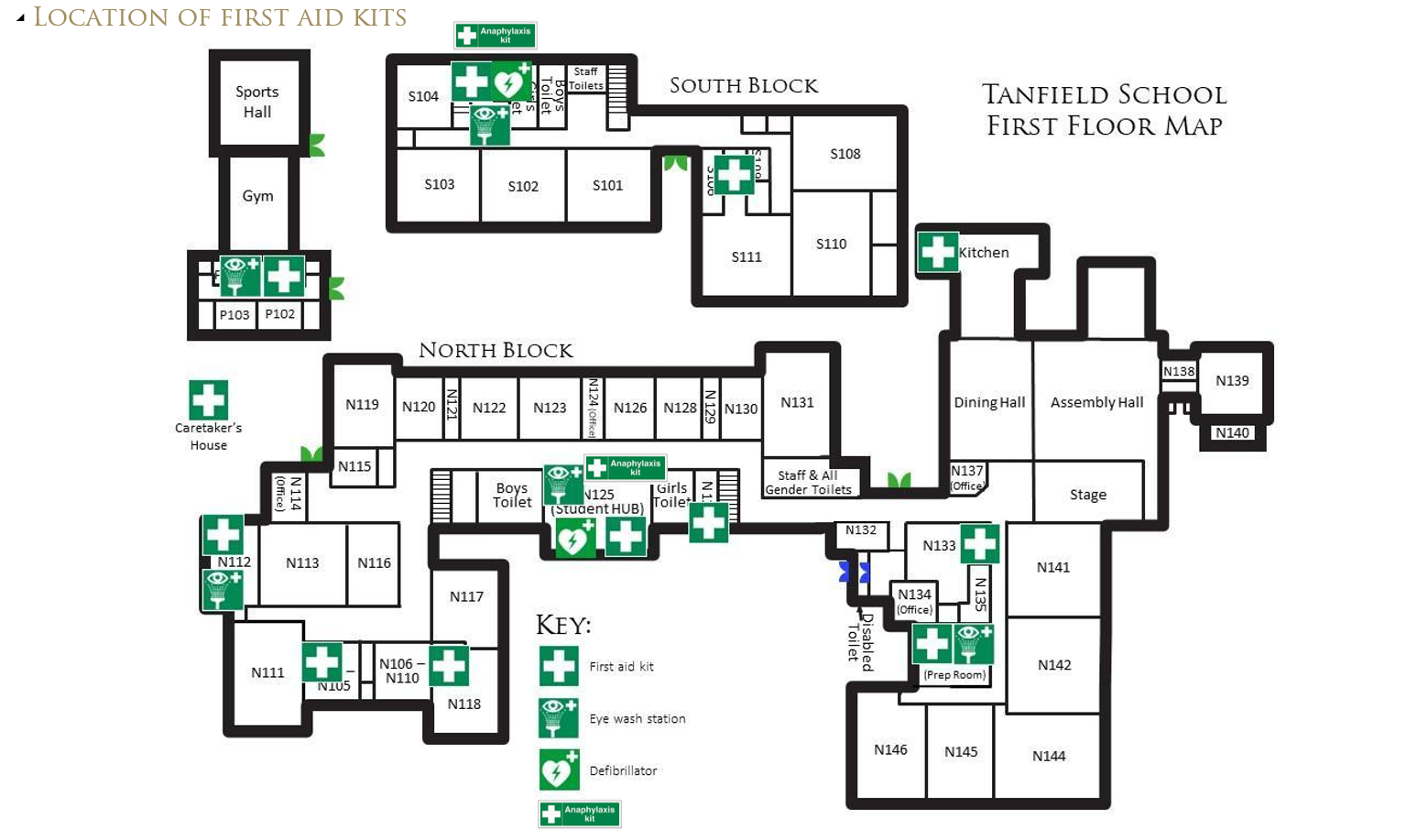
Emergency Inhaler boxes are located in the Year Manager Hub, PE Office and S105. Each box contains an emergency inhaler - these are to be used only where consent has been previously gained from parents / carers, and a list of students with consent.
5.2 Defibrillator
A defibrillator is available in the student hub (N125) and another in (S105). These devices are only to be used by qualified and competent first aiders or as directed by a member of the emergency services.
5.3 Emergency Anaphylaxis Kits (EpiPen Adrenaline Injectors)
Emergency anaphylaxis kits are available in the student hub (N125) and S105. Each kit contains 1 EpiPen Adrenaline Injector. These devices are only to be used by qualified and competent first aiders or as directed by a member of the emergency services. For more in-depth information, please refer to the school separate Allergy Policy: Benedicts Law.
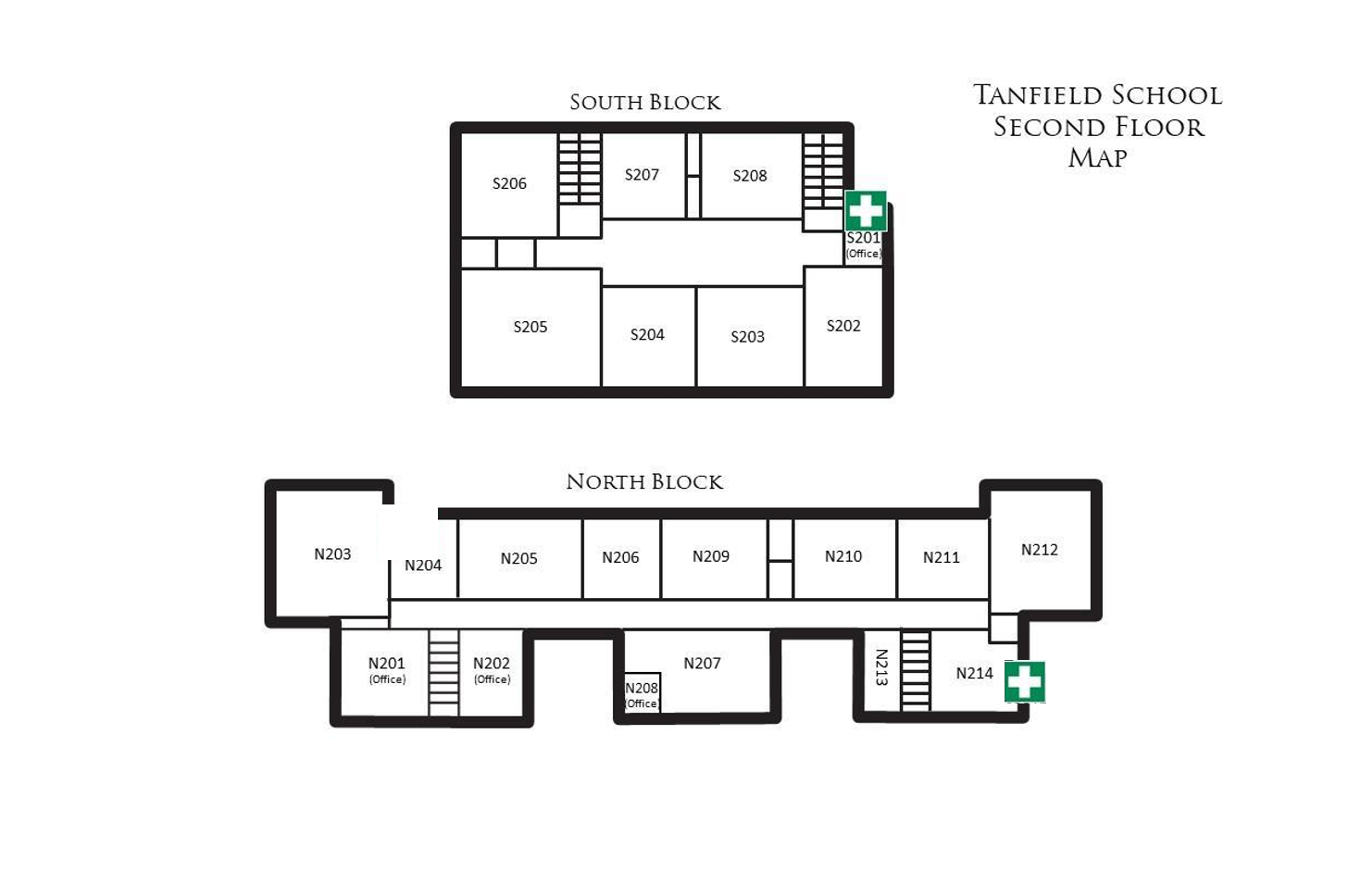
Locations of first aid kits, defibrillators, and anaphylaxis kits are shown in appendix 2.
6. Record-keeping and reporting
6.1 First aid and accident record
A First Aid Form will be completed by the first aider on the same day or as soon as possible after a minor incident involving a student requiring first aid treatment (http://healthandsafety.tanfieldschool.co.uk).
An Accident / Incident / Ill-Health or Near Miss Report Form will also be completed by the first aider on the same day, or as soon as possible, after a moderate or major incident involving a student and Caroline Dixon informed.
An Accident / Incident / Ill-Health or Near Miss Report Form will be completed by the first aider on the same day, or as soon as possible, after any incident involving a member of staff, contractor or visitor.
If required, seek further advice on which form(s) need to be completed from our appointed person, Caroline Dixon
As much detail as possible should be supplied when reporting an accident.
A copy of the accident report will be added to the student’s educational record by Caroline Dixon.
Records will be held digitally for a minimum period of 3 years, in accordance with regulation 25 of the Social Security (Claims and Payments) Regulations 1979, and then disposed of.
6.2 Reporting to the HSE
The Health & Safety Team will keep a record of any accident which results in a reportable injury, disease, or dangerous occurrence as defined in the RIDDOR 2013 legislation (regulations 4, 5, 6, and 7).
The Health & Safety Team will report these to the Health and Safety Executive as soon as is reasonably practicable and in any event within 10 days of the incident.
Reportable injuries, diseases or dangerous occurrences include:
Death
Specified injuries, which are:
Fractures, other than to fingers, thumbs and toes
Amputations
Any injury likely to lead to permanent loss of sight or reduction in sight
Any crush injury to the head or torso causing damage to the brain or internal organs
Serious burns (including scalding)
Any scalping requiring hospital treatment
Any loss of consciousness caused by head injury or asphyxia
Any other injury arising from working in an enclosed space which leads to hypothermia or heat-induced illness, or requires resuscitation or admittance to hospital for more than 24 hours
Injuries where an employee is away from work or unable to perform their normal work duties for more than 7 consecutive days (not including the day of the accident
Where an accident leads to someone being taken to hospital
Near-miss events that do not result in an injury, but could have done. Examples of near-miss events relevant to schools include, but are not limited to:
The collapse or failure of load-bearing parts of lifts and lifting equipment
The accidental release of a biological agent likely to cause severe human illness
The accidental release or escape or any substance that may cause a serious injury or damage to health
An electrical short circuit or overload causing a fire or explosion
Information on how to make a RIDDOR report is available here:
7. Training
All school staff are able to undertake first aid training if they would like to.
All first aiders must have completed a training course, and must hold a valid certificate of competence to show this. The school will keep a register of all trained first aiders, what training they have received and when this is valid until.
Staff are encouraged to renew their first aid training when it is no longer valid.
8. Monitoring arrangements
This policy will be reviewed by the Health & Safety Team every 2 years.
At every review, the policy will be approved by the headteacher and/or governing board.
Appendix 1
List of appointed persons and first aiders
Staff member’s name | Role | Contact details |
Caroline Dixon | Appointed Person and First Aider (FAW) – Assistant SENDCo | Internal Line 443253 |
Adam Chrostowski | First aider (FAW) - PE | Internal line:44322 |
Graeme Davison | First aider (FAW) – Year Manager | 07825555396 |
Marie Farrell | First aider (FAW) – Year Manager | 07825 555 365 |
Alex Jeffrey | First aider (FAW) – PE | Internal line: 443227 |
Rob McConnell | First aider (FAW) – PE | Internal line: 443227 |
Grant Parker | First aider (FAW) – Year Manager | 07825555419 |
Matthew Pearson | First aider (FAW) – Business Services | 07503641175 |
Laura Shotton | First aider (FAW) - Teacher of English | Internal line: 443231 |
Matt Smith | First aider (FAW) – Year Manager | 07824184655 |
Appendix 2