Name | Role | Contact details |
Mr S Clough | Head Teacher | |
Mr C Jones | Deputy Head Teacher | |
Mrs V Elliott | Attendance & Welfare Officer | |
Mrs C Daglish | Home School Liaison Officer | |
Mr G Davison | Year Manager, Year 7 | |
Mr G Parker | Year Manager, Year 8 | |
Mrs H Johnson | Year Manager, Year 9 | |
Mrs M Farrell | Year Manager, Year 10 | |
Mr M Smith | Year Manager, Year 11 | |
Mr M Creegan | Head of School Guidance Lower School | |
Mr M Heffernan | Head of School Guidance Upper School |
Attendance Policy
Attendance
Table of Contents
1. Attendance Key Contact List
2. Aims
Tanfield School seeks to ensure that all of its students receive an education which maximises opportunities for each student to realise their true potential. The school will strive to provide a calm, orderly, safe, and supportive environment where all students want to be and are keen and ready to learn within a culture that promotes the benefits of high attendance.
Regular school attendance plays a vital role in children’s wellbeing and education, ensuring that their current learning needs are being met but also building their future ability to learn.
As attendance is the essential foundation to positive outcomes for all students’, improving attendance is everyone’s business, a concerted effort across all teaching and non-teaching staff in school, the governing body, the local authority, and other local partners.
Some students find it harder than others to attend school and therefore at all stages of improving attendance, the school and partners will work with students and parents to remove any barriers to attendance by building strong and trusting relationships and working together to put the right support in place.
We recognise that the relationship between the attendance and achievement of school is inextricably linked
This policy is supported by our policies on safeguarding, bullying and behaviour.
We are committed to meeting our obligation with regards to school attendance through our whole-school culture and ethos that values good attendance, including:
Promoting good attendance.
Reducing absence, including persistent and severe absence.
Ensuring every student has access to the full-time education to which they are entitled.
Acting early to address patterns of absence.
Building strong relationships with families to ensure students have the support in place to attend school.
We will also promote and support punctuality in attending lessons.
This policy meets the requirements of the working together to improve school attendance from the Department for Education (DfE), and refers to the DfE’s statutory guidance on school attendance parental responsibility measures. These documents are drawn from the following legislation setting out the legal powers and duties that govern school attendance:
Part 6 of The Education Act 1996
Part 3 of The Education Act 2002
Part 7 of The Education and Inspections Act 2006
The Education (Student Registration) (England) Regulations 2006 (and 2010, 2011, 2013, 2016 amendments)
The Education (Penalty Notices) (England) (Amendment) Regulations 2013
This policy also refers to the DfE’s guidance on the school census, which explains the persistent absence threshold.
3. Why is regular attendance so important?
Being in school every day that it is open, is important to your child’s achievement, wellbeing, and their wider development. There is a renewed national focus on maximising students’ time in the classroom, as evidence shows that the schools with the highest attendance throughout their time in school gain the best GCSE results.
3.1 Here’s what the data shows:
Students with higher attainment at KS4 had lower levels of absence over the key stage compared to those with lower attainment.
Students who did not achieve grade 9 to 4 in English and maths GCSEs in 2019 had an overall absence rate of 8.8% over the key stage, compared with 5.2% among students who achieved a grade 4 and 3.7% among students who achieved grade 9 to 5 in both English and maths.
Generally, the higher the percentage of sessions missed across key stage KS4, the lower the level of attainment at the end of the key stage.
Among pupils with no missed sessions over KS4, 83.7% achieved grades 9 to 4 in English and maths compared to 35.6% of pupils who were persistently absent.
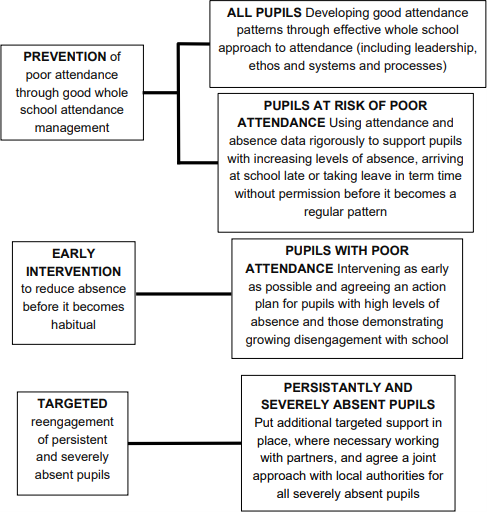
4. The school and all partners will work together to:
EXPECT |
|---|
Aspire to high standards of attendance from all pupils and parents and build a culture where all can, and want to, be in school and ready to learn by prioritising attendance improvement across the school. |
MONITOR |
Rigorously use attendance data to identify patterns of poor attendance (at individual and cohort level) as soon as possible so all parties can work together to resolve them before they become entrenched. |
FACILITATE SUPPORT |
Remove barriers in school and help pupils and parents to access the support they need to overcome the barriers outside of school. This might include an early help or whole family plan where absence is a symptom of wider issues. |
FORMALISE SUPPORT |
Where absence persists and voluntary support is not working or not being engaged with, partners should work together to explain the consequences clearly and ensure support is also in place to enable families to respond. Depending on the circumstances this may include formalising support through a parenting contract or education supervision order. |
LISTEN AND UNDERSTAND |
When a pattern is spotted, discuss with pupils and parents to listen to understand barriers to attendance and agree how all partners can work together to resolve them. |
ENFORCE |
Where all other avenues have been exhausted and support is not working or not being engaged with, enforce attendance through statutory intervention or prosecution to protect the pupil’s right to an education. |
5. Tanfield School will ensure that:
All students have an equal right, and access to an education in accordance with the national curriculum, or agreed alternative.
Students will not be deprived of their education opportunities by either their own absence or lateness, or that of other students.
Action is taken where necessary to secure an improvement in attendance.
It is recognised that:
The majority of students want to attend school to learn, to socialise with peers, and to prepare themselves fully to take their place in society.
Students and their families may need to be supported at some stage in meeting attendance obligations and responsibilities.
Students who attend and / or make significant improvements need to be rewarded and recognised.
It is the responsibility of parents / carers to ensure their children’s attendance to school as required by law (ref: Section 7, 1996 Education Act).
6. Roles and Responsibilities
As part of our school approach to maintaining high attendance, Tanfield School will:
Ensure that the importance of attendance is made clear by promoting the relevant school policies and guidance directed at parents and staff.
Annually review the school’s attendance policy and ensure that all provisions are in place to allow staff, parents, and schools to implement the policy effectively.
Ensure that the school is implementing effective means of recording attendance and organising that data, including for children who are educated off-site.
The Attendance Officer or Home School Liaison Officer will investigate poor attendance.
Invite parents/carers into school to discuss attendance concerns and plan a resolution.
Where intervention is not successful, parents and schools may be referred to Durham County Council’s Attendance Improvement Team for further investigation.
Where intervention attempts have failed consideration will be given to the issue of a FPN (fixed penalty notice - fine) or prosecution at magistrates Court under section 444 of the Education Act 1996
6.1 The governing body
The governing board is responsible for:
Promoting the importance of school attendance across the school.
Making sure school leaders fulfil expectations and statutory duties.
Regularly review and challenge attendance data.
Monitoring attendance figures for the whole school
Making sure staff receive adequate training on attendance
Holding the headteacher to account for the implementation of this policy.
The Pupil Welfare Committee is responsible for monitoring student attendance.
6.2 The Deputy Headteacher
The deputy headteacher is the senior leader who is responsible for:
Leading attendance across the school
Offering a clear vision for attendance improvement
Evaluating and monitoring expectations and processes
Having an oversight of data analysis
Devising specific strategies to address areas of poor attendance identified through data
6.3 The Attendance & Welfare Officer
The school Attendance & Welfare Officer is responsible for:
Completing first day absence.
Create and review support plans for students with an unacceptable level of attendance.
Contacting parents of students who are absent on the first day of absence.
Ensuring all attendance codes are accounted for
Arranging calls and meetings with parents to discuss attendance issues
Delivering targeted intervention and support to students and families
Regularly monitor and analyse attendance and absence data to identify students or cohorts that require support with their attendance and put effective strategies in place.
Build strong relationships with families, listen to and understand barriers to attendance and work with families to remove them.
Reports concerns about attendance to the Deputy Headteacher/ Year Managers and log on CPOMS
Benchmarking attendance data to identify areas of focus for improvement
Providing regular attendance reports to school staff and reporting concerns about attendance to the designated senior leader responsible for attendance and the headteacher
Working with the Local Authority Attendance Improvement Team to tackle persistent and severe absence.
Refer appropriate cases to Local Authority Attendance Improvement Team who issue fixed-penalty notices. Records kept on CPOMS. The Attendance and Welfare Officer will ensure the school complies with all relevant government legislation and that they will work professionally with parents, carers, schools and relevant agencies to secure improvements in attendance via appropriate support or sanctions.
Advising the Deputy Headteacher (authorised by the headteacher) when to issue fixed-penalty notices
The attendance officer is Mrs V Elliott and can be contacted via velliott@tanfieldschool.co.uk
6.4 Year Managers
Monitor attendance for all students in their year group.
Work closely with the Attendance Officer or Home School Liaison Officer to identify any students who are a concern and improve attendance for all students.
Create and review support plans for students with an unacceptable level of attendance.
Will contact parents immediately when a student is absent from school.
Will meet with students and parents where there are attendance concerns.
Keep a record of any communication regarding absence and log concerns in CPOMs.
Praise students with good or improved attendance
Complete home visits when necessary.
6.5 Home School Liaison Officer
Work closely with the Attendance Officer and Pastoral Team to improve
Complete first day absence when necessary.
Contacting parents of students who are absent on the first day of absence.
Arranging calls and meetings with parents to discuss attendance issues
Delivering targeted intervention and support to students and families.
Complete home visits and bring in to school and students who are absent for no reason or refusing to come to school.
Regularly monitor and analyse attendance and absence data of key students who require support with their attendance and put effective strategies in place.
Build strong relationships with families, listen to and understand barriers to attendance and work with families to remove them.
Reports concerns about attendance to the Attendance Officer, Deputy Headteacher/ Year Managers and log on CPOMS
Providing regular case reports to school staff and reporting concerns about attendance to the designated senior leader responsible for attendance and the headteacher
Arranges calls and meetings with parents to discuss attendance issues.
The Home School Liaison Officer is Mrs C Daglish and can be contacted via cdaglish@tanfieldschool.co.uk
6.6 Teachers (advisors) and support staff
Are responsible for recording attendance on a daily basis in Arbor. Staff must mark registers, on time and accurately using the correct codes, and submit this information. Registers should be taken within the first 10 minutes of a lesson, morning meeting or afternoon meeting.
Ensure that they fully understand and are following the correct systems for recording attendance and that attendance is taken each lesson and session.
Any student who is known to be in school but not in a lesson must be marked in Arbor as absent and reported as immediately as missing. This should be reported to a member of the pastoral team or business support via the on-call system.
Should be active in their approach to promoting good attendance to students and their parents, which include forming honest, open relationships with families.
Ensure that the school’s teaching and learning experiences encourage regular attendance and that students are taught the value of high attendance for their own personal progression and achievement.
Ensure that the Attendance & Welfare Officer/Year Managers are kept fully aware and up to date with any concerns relating to the student that may impact on their attendance.
In the event of a fire/drill advisors will accurately take paper registers provided by business support. Any school missing must be reported immediately to a member of SLT or the pastoral team.
6.7 Parents and carers
As part of our school approach to maintaining high attendance, we expect that parents/carers are expected to:
Make sure their child attends school every day during term time and is on time.
Call the school to report their child’s absence before 8.30am on the day of the and each subsequent day of absence, and advise when they are expected to return.
Provide the school with more than 1 emergency contact number for their child
Engage with their children’s education – support their learning and take an interest in what they have been doing at the school.
Promote the value of good education and the importance of regular school attendance at home.
Depending on the nature of absence and illness their child should be encouraged to join online lessons to ensure they do not fall behind with their school work. This is dependent on the student being well enough.
There is an expectation that students should still try to complete homework during periods of absence. This will be reviewed on an individual basis.
Do everything they can to prevent unnecessary school absences, such as making medical and dental appointments outside of school hours.
Work with the Attendance & Welfare Officer when required to secure an improvement in attendance.
Keep the School informed of any circumstances which may affect their child’s attendance and work with staff in resolving any issues that may be having an impact on their child.
Enforce a regular routine at home in terms of homework, bedtime, etc. so that the child is used to consistency and the school day becomes part of that routine. It is vital that the child receives the same message at home as they do at the School about the importance of attendance.
Do not take their children out of the school for holidays during term time. Parents do NOT have the right to remove their child from education without prior permission from the Headteacher. If parents would like to make a special request for a Leave of Absence due to exceptional circumstances, they may do so by following the Leave of Absence procedures (as detailed in section 4). The Headteacher has the right to refuse requests for any Leave of Absence in accordance with Local Authority Guidelines.
Schools and families will be monitored and supported on an individual basis, considering the school and family needs, environmental factors, agency involvement and any other concerns. Support and / or sanctions will be determined by these factors.
Actively encourage and support your child in attending after school sessions to catch up on any missing learning
6.8 Students
Students are expected to:
Attend school every day on time
Attend every timetabled session on time.
Catch up on missing school work if absent.
Complete any outstanding homework if absent.
Attend after school session to catch up on missing work.
7. Recording attendance
7.1 Attendance register
Tanfield School records attendance using Arbor. Categories of absence and procedure for reporting absences Attendance register. By law, all schools (except those where all students are boarders) are required to keep an attendance register, and all students must be placed on this register.
The attendance register will be taken at the start of the first session of each school day and once during the second session. It will mark whether every student is:
Present
Attending an approved off-site educational activity
Absent
Unable to attend due to exceptional circumstances
Unable to attend due to self-isolation/ quarantine in relation to COVID 19 monitoring criteria.
Any amendment to the attendance register will include:
The original entry
The amended entry
The reason for the amendment
The date on which the amendment was made
The name and position of the person who made the amendment.
We will record:
Whether the absence is authorised or not
The nature of the activity if a student is attending an approved educational activity
The nature of circumstances where a student is unable to attend due to exceptional circumstances.
Every entry in the attendance register will be preserved for 3 years after the date on which the entry was made:
Students must arrive in school by 8.30am on each school day.
The register for the first session will be taken at 8.40am and will be kept open until 9.10am. The register for the second session will be taken at period 5 (12.35pm & 1.25pm) and will be kept open for 30 minutes after the beginning of each period.
See appendix 1 for the DfE attendance codes.
7.2 Unplanned absence and illness
Parents must notify the School on the first day of an unplanned absence – for example, if their child is unable to attend due to ill health – by 8.30am or as soon as practically possible (see also section 6). This can be done either by phone call, Arbor, text message to your child’s Year manager or email to the school.
For students with attendance above 95% absence due to illness, this is likely to be authorized, unless the school has a genuine concern about the authenticity of the illness.
the authenticity of the illness is in doubt or the student’s attendance is below 95%, the school may ask parents to provide medical evidence, such as a doctor’s note, prescription, appointment card or other appropriate form of evidence. We will not ask for medical evidence unnecessarily.
If the School is not satisfied about the authenticity of the illness, the absence will be recorded as unauthorised, and parents will be notified of this in advance.
7.3 Planned absence
Medical or Dental Appointments
Attending a medical or dental appointment will be counted as authorised as long as the student’s parent/carer notifies the school in advance of the appointment.
However, we encourage parents/carers to make medical and dental appointments out of school hours where possible. Where this is not possible, the student should be out of school for the minimum amount of time necessary e.g. if it is a morning appointment the student should try to attend school for the afternoon school session.
7.4 Authorised absences
The student’s parent/carer must also apply for other types of term-time absence as far in advance as possible of the requested absence. Go to section 5 to find out which term-time absences the school can authorise.
There may be some instances where the school will authorise absence such as for a family bereavement. All authorised absences other than medical appointments or illness require a Leave of Absence form to be completed. These can be collected from reception or by contacting school.
7.5 Lateness and punctuality
8.30am - All students should be on site - This ensures a prompt and purposeful start to the day, so all students are ready to learn and prepared for success.
The school gate will close at 8.37am. Students arriving after this time need to report to main reception and will be recorded as late to morning line up. Unless they have a valid reason they will be given an after school detention. It is vital that students sign in at reception to ensure that appropriate health and safety regulations are followed and that all students are accounted for.
8.40am - is recorded as late in the register: Students arriving after 8.40am without a valid reason, will be recorded as late in the register. They will receive a negative point and an after school detention.
9.10am registration closes: Students arriving after the register closes at 9.10am will be recorded as an unauthorised absence. Where there are 10 sessions of unauthorised late marks (Code U), this will be referred to the Local Authority for a Fixed Penalty Notice (fine) to be issued.
The Attendance Officer will investigate any concerns regarding lateness. Parents will be invited into school to meet and discuss reasons for lateness and in some cases a referral will be made to the Local Authority Attendance Team who will then consider the need to follow legal proceedings to secure regular and punctual attendance.
7.6 Following up absence
When a parent/carer contacts school they will receive a follow up call to discuss their child’s absence.
A member of the office staff will make an initial welfare call for any student with attendance over 95%
Year Managers will make a welfare call or home visit when a student is absent and has attendance lower than 95%
The Attendance Officer or Home School Liaison Officer will make follow up phone calls for those students who are persistently or severely absent.
7.7 Following up unexplained absence
Where any student we expect to attend school does not attend, or stops attending, without reason:
The Attendance Officer or Home School Liaison Officer will call the student’s parent/carer on the morning of the first day of unexplained absence to ascertain the reason. If the school cannot reach any of the student’s emergency contacts, the school complete a home visit. The school will continue to call the parent/carer on each day that the absence continues without explanation to ensure proper safeguarding action is taken where necessary. Where there are concerns, the school will contact the police or Social Services.
The school will Identify whether the absence is approved or not
The school will Identify the correct attendance code to use and input it as soon as the reason for absence is ascertained – this will be no later than 5 working days after the session
If absence continues, the school will consider involving the Local Authority Attendance Improvement Team
8. Suspension from School
A suspension from School is treated as an authorised absence. These will be dealt with in line with the School’s Behaviour. If a student is suspended from school they are to remain in the house and not to be in a public place during the hours of the school day. The parents/carers of any student found in public during this time will receive a fixed penalty notice.
9. SEND and health-related absences
In line with the SEND Policy and Supporting Pupils with Medical Conditions Policy, the school will ensure that reasonable adjustments are made for disabled pupils to reduce barriers to attendance, in line with any EHC plans or IHPs that have been implemented. The school will secure additional support from external partners to help bolster attendance where appropriate.
Where the school has concerns that a pupil’s non-attendance may be related to mental health issues, parents will be contacted to discuss the issue and whether there are any contributory factors to their child’s lack of attendance.
Where staff have a mental health concern about a pupil that is also a safeguarding concern, they will inform the DSL and the Child Protection and Safeguarding Policy will be followed. All pupils will be supported with their mental health in accordance with School Policies.
If a pupil is unable to attend school for long periods of time due to their health, the school will:
Inform the LA if a pupil is likely to be away from the school for more than 15 school days.
Provide the LA with information about the pupil’s needs, capabilities and programme of work.
Make sure the pupil is kept informed about school events and clubs.
Encourage the pupil to stay in contact with other pupils during their absence.
Help the pupil reintegrate at school when they return.
The school will incorporate an action plan to help any pupils with SEND and/or health issues cope with the stress and anxiety that attending school may cause them. Such plans will be regularly monitored and reviewed until the pupil is attending school as normal and there has been signs of significant improvement. To support the attendance of pupils with SEND and/or health issues, the school will consider:
Holding termly meetings to evaluate any implemented reasonable adjustments.
Incorporating a pastoral support plan.
Carrying out strengths and difficulties questionnaire.
Identifying pupils’ unmet needs through the Common Assessment Framework.
Using an internal or external specialist.
Enabling a pupil to have a reduced timetable
Ensuring a pupil can have somewhere quiet to spend lunch and breaktimes.
Implementing a system whereby pupils can request to leave a classroom if they feel they need time out.
Temporary late starts or early finishes.
Phased returns to school where there has been a long absence.
Small group work or on-to-one lessons.
Tailored support to meet their individual needs.
10. Authorised and unauthorised absence
10.1 Approval for term-time absence
The headteacher will only grant a leave of absence to a student during term time if they consider there to be 'exceptional circumstances'. A leave of absence is granted at the headteacher’s discretion, including the length of time the student is authorised to be absent for.
The school considers each application for term-time absence individually, taking into account the specific facts, circumstances and relevant context behind the request.
Any request should be submitted as soon as it is anticipated and, where possible, at least 4 weeks in advance. The school may require evidence to support any request for leave of absence.
Valid reasons for authorised absence include:
Illness and medical/dental appointments
Religious observance
The school recognises that there may be times where children of different faiths observe religious festivals that fall outside of school holidays and weekends and will allow authorised absence for these times. These absences will be verified by the Attendance Officer in conjunction with Durham County Council as they hold the official record for dates of religious observance.
Parents will be aware of these dates and should give the school written notification in advance.
10.2 Occupational purposes
Traveller students travelling for occupational purposes – this covers Roma, English and Welsh Gypsies, Irish and Scottish Travellers, Showmen (fairground people) and Circus people, Bargees (occupational boat dwellers) and New Travellers. Absence may be authorised only when a Traveller family is known to be travelling for occupational purposes and has agreed this with the school, but it is not known whether the student is attending education
10.3 Family holidays and extended leave
We do not permit absence for holiday periods. However, it is within the headteacher’s power (or deputy headteacher, authorised by the headteacher) to grant an authorised leave of absence for exceptional circumstances examples of exceptional circumstances could include overseas family issues / emergencies, health related issues and associated recovery, exceptional opportunities that would enhance the life experiences of the school. (The circumstances will be considered individually before a decision is made).
No authorisation is possible without a completed leave of absence from. (Available from reception). We ask parents to give at least 6 weeks’ notice.
All requests for authorised absence will be responded to in writing and will outline the details of any possible sanctions. All information regarding leave of absence will be passed to the Attendance Officer who will follow Local Authority procedures for unauthorised absence. Parents should contact the School immediately if there will be a cause for delay from the stated date of return.
The Department for Education has recently announced national changes to the penalty notices for unauthorised absences / holidays during term time. This change will come into effect on 19th August 2024. This means from the start of the new academic year, September 2024, fixed penalty notices will be issued for unauthorised leave of absences holidays and for irregular school attendance as follows:
Trigger: 10 sessions or 5 days of unauthorised absence in a 10 week rolling period
First Offence (within a 3 year rolling period): £160 per parent/carer per child if paid within 28 days (reduced to £80 per parent/carer per child if paid within 21 days)
Second Offence (within a 3 year rolling period): £160 per parent/carer per child (no reduction for for early payment)
Third Offence (within a 3 year rolling period): A fixed penalty notice will not be issued. This will be presented straight to the Magistrate’s Court where a fine of up to £2,500 per parent/carer per child may be issued.
Please note that this new legislation will come into force for any term time leave of absence taken from September 2024, regardless of when the holiday was booked.
Application forms can be requested by contacting the school office. If we suspect that a leave of absence has been taken without permission, follow up checks will be made including home visits.
10.4 Frequently Asked Questions
What does the law say about leave of absence in term time?
It says Head Teachers may not grant any leave of absence during term time unless there are exceptional circumstances. Head Teachers should determine the number of school days a child can be away from school if the leave is granted.
If my child’s school refuses to authorise my term time leave of absence request, will I receive a Fixed Penalty Notice and can I be prosecuted?
Durham County Council’s Fixed Penalty Notice Protocol acknowledges that regular and punctual attendance at school is both a legal requirement and essential for pupils to maximise their educational opportunities.
Circumstances where a Penalty Notice might be issued include unauthorised leave of absence in term time, or other parentally condoned absence where the absence amounts to five school days or more in a minimum ten rolling school week period. You can be prosecuted if you receive a fixed penalty notice and it is not paid.
Under the Education Act 1996, parents commit an offence if they fail to ensure their child’s regular school attendance. Taking a child out of school for a leave of absence without permission, and where the absence amounts to seven school days or more of unauthorised absence in a minimum twelve week rolling term is viewed as failing to ensure your child’s regular attendance at school.
Payment of a Penalty Notice, where offered, is an alternative to prosecution. If unpaid, prosecution for the Education Act offence may therefore ensue. A fixed penalty notice will be issued to each person with parental responsibility for the child / children who are deemed liable for the offence / offences.
Who has parental responsibility for a child?
The Department for Education (DfE) state a parent means:
All natural parents, whether they are married or not;
Any person who has parental responsibility for a child or young person; and,
Any person who has care of a child or young person i.e., lives with and looks after the child.
The DfE further state: ‘generally parents include all those with day to day responsibility for a child.’
11. Monitoring Attendance
11.1 Attendance monitoring for schools at risk/ vulnerable
All schools are monitored closely including all schools who are currently recorded as vulnerable or at risk. Full and contemporaneous evidence is gathered and all causes for concern are recorded / reported / acted upon immediately with appropriate staff and external agencies. Safeguarding procedures and agency referral procedures are followed. Vulnerability and risks include safeguarding, young carers, risk of criminality, youth offending service, substance misuse, Child Sexual Exploitation, mental health, parental mental health and parental learning disabilities and those missing from education. This list is not exhaustive.
11.2 Missing children
The LA procedures to safeguard missing children states that the Attendance Officer (where a school does not buy the service of an EWO) should be responsible for the check and contacting the CME officer at Durham County Council. Procedures should be followed and removal of a child from roll ONLY in strict accordance with regulation 8(h)(iii) of the (Student Registration Education) Regulations 2006.
THIS ONLY applies to children who have moved from the area to an UNKNOWN location, and the school at which the child is currently registered has not been informed of a new address or new school. It must NOT be used if an address or location IS known. Evidence must be gathered to prove reasonable enquiries have been made to establish the whereabouts of the child and family.
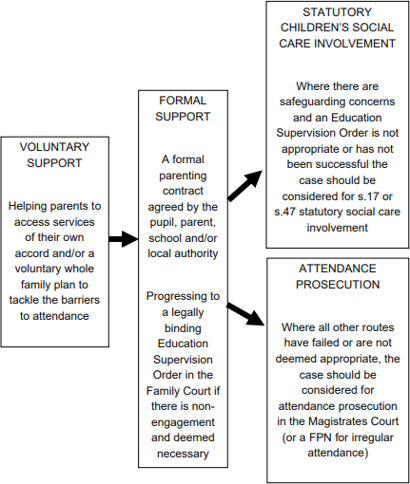
The School and LA will make use of the full range of legal interventions rather than relying solely on fixed penalty notices or prosecution. It is for individual schools and local authorities to decide whether to use them in an individual case after considering the individual circumstances of a family.
These are:
- Parenting contracts
- Education supervision orders
- Attendance prosecution
- Parenting orders
- Fixed penalty notices 91.
Local authorities can fine parents for the unauthorised absence of their child from school, where the child is of compulsory school age.
If issued with a penalty notice, parents must pay £60 within 21 days or £120 within 28 days. The payment must be made directly to the local authority.
A referral to the Local Authority will be made dependent on criteria being met. This may take into account:
- Several unauthorised absences occurring within a rolling academic year
- One-off instances of irregular attendance, such as holidays taken in term time without permission
- Where an excluded student is found in a public place during school hours without a justifiable reason
If the payment has not been made after 28 days, the local authority can decide whether to prosecute the parent or withdraw the notice.
Strategies for promoting attendance
- Regular communication with parents
- Weekly displays of attendance by week and to date in assembly to ensure continuous whole school focus.
- Online facilities for parents to see school attendance
- “Pink slip” system for schools with persistent absence to complete missed work and minimize impact on learning
- Back to school interviews to identity if further support is required for reintegration
- Lunchtime queue jumpers for sept groups with 100% for 1 week
- Other intervention strategies are used throughout the year.
11.3 Attendance monitoring
The school will:
- Monitor attendance and absence data half-termly, termly and yearly across the school and at an individual student level
- Identify whether or not there are particular groups of children whose absences may be a cause for concern
- Student-level absence data will be collected each term and published at national and local authority level through the DfE's school absence national statistics releases. The underlying school-level absence data is published alongside the national statistics. The school will compare attendance data to the national average, and share this with the governing board.
Year Managers, the Attendance Officer, Home School Liaison Officer and Deputy Headteacher monitors student absence daily.
Parents are expected to call the School in the morning if their child is going to be absent due to ill health.
School will attempt to make a follow up call on the first day of your child’s absence, regardless if parents/carers have informed school of their child’s absence.
If a student’s absence goes above 2 days, we will contact the parents again to discuss the reasons for this.
If after contacting parents a student’s absence continue to rise, we will consider involving the Local Authority Attendance Team.
The persistent absence threshold is 10%. If a student's individual overall absence rate is greater than or equal to 10%, the student will be classified as a persistent absentee and a referral to the Local Authority Attendance Team will be made.
Student-level absence data is collected each term and published at national and local authority level through the DfE's school absence national statistics releases. The underlying school-level absence data is published alongside the national statistics. We compare our attendance data to the national average and share this with governors.
11.4 Analysing attendance
The school will:
- Analyse attendance and absence data regularly to identify students or cohorts that need additional support with their attendance, and use this analysis to provide targeted support to these students and their families.
- Look at historic and emerging patterns of attendance and absence, and then develop strategies to address these patterns.
11.5 Using data to improve attendance
The school will:
- Provide regular attendance reports to key staff and other school leaders, to facilitate discussions with students and families
- Use data to monitor and evaluate the impact of any interventions put in place in order to modify them and inform future strategies
11.6 Reducing persistent and severe absence
Persistent absence is where a student misses 10% or more of school, and severe absence is where a student misses 50% or more of school.
The school will:
- Use attendance data to find patterns and trends of persistent and severe absence
- Hold regular meetings with the parents of students who the school (and/or local authority) considers to be vulnerable, or are persistently or severely absent, to discuss attendance and engagement at school.
- Create a personal support plan with parents and students and agree targets to support students improving attendance.
- Provide access to wider support services to remove the barriers to attendance
Appendix 1: Attendance Codes
The following codes are taken from the DfE’s guidance on school attendance.
Code | Definition | Scenario |
/ | Present (am) | Student is present at morning registration |
\ | Present (pm) | Student is present at afternoon registration |
L | Late arrival | Student arrives late before register has closed |
B | Off-site educational activity | Student is at a supervised off-site educational activity approved by the school |
D | Dual registered | Student is attending a session at another setting where they are also registered |
J1 | Interview | Student has an interview with a prospective employer/educational establishment |
K | Attending education provision arranged by the local authority | Student attending a place, other than the school or any other school at which they are a registered pupil, for educational provision arranged by a local authority under section 19(1) of the Education Act 1996 |
P | Sporting activity | Student is participating in a supervised sporting activity approved by the school |
V | Educational trip or visit | Student is on an educational visit/trip organised, or approved, by the school |
W | Work experience | Student is on a work experience placement |
Code | Definition | Scenario |
Authorised Absence | ||
C | Authorised leave of absence | Student has been granted a leave of absence due to exceptional circumstances |
E | Excluded | Student has been excluded but no alternative provision has been made |
H | Authorised holiday | Student has been allowed to go on holiday due to exceptional circumstances |
I | Illness | School has been notified that a student will be absent due to illness |
M | Medical/dental appointment | Student is at a medical or dental appointment |
R | Religious observance | Student is taking part in a day of religious observance |
T | Gypsy, Roma and Traveller absence | Student from a Traveller community is travelling, as agreed with the school |
Unauthorised Absence | ||
G | Unauthorised holiday | Student is on a holiday that was not approved by the school |
N | Reason not provided | Student is absent for an unknown reason (this code should be amended when the reason emerges, or replaced with code O if no reason for absence has been provided after a reasonable amount of time) |
O | Unauthorised absence | School is not satisfied with reason for student's absence |
U | Arrival after registration | Student arrived at school after the register closed |
Code | Definition | Scenario |
X | Not required to be in school | Student of non-compulsory school age is not required to attend |
Y | Unable to attend due to exceptional circumstances | School site is closed, there is disruption to travel because of a local/national emergency, or student is in custody |
Z | Student not on admission register | Register set up, but student has not yet joined the school |
# | Planned school closure | Whole or partial school closure due to half- term/bank holiday/INSET day |